
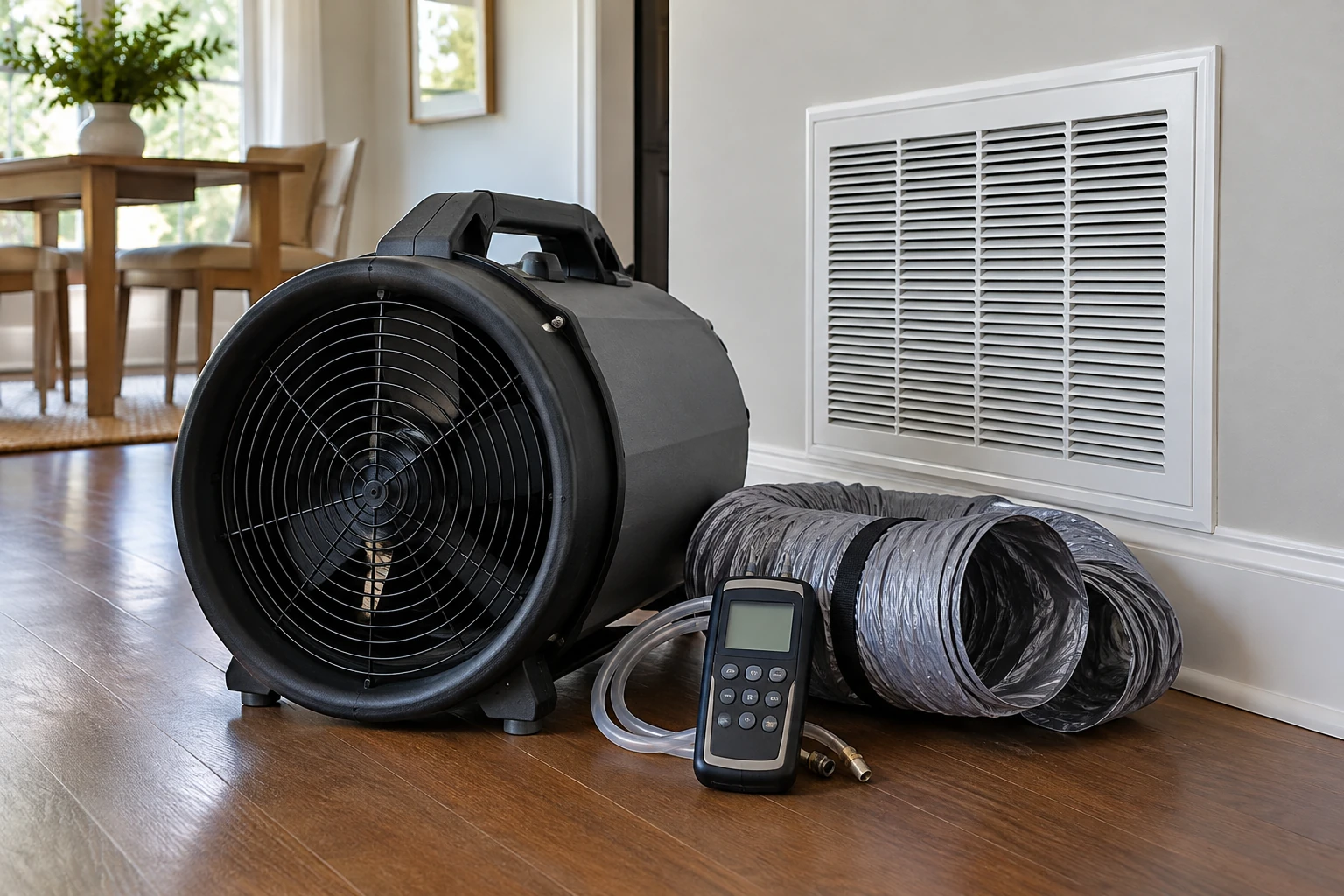
A duct leakage test measures air escaping from a duct system under specified test conditions. It can give you evidence to discuss before authorizing duct work, but a number without its test method, system boundary, and units is difficult to interpret.
The useful question is not simply, “Did my ducts pass?” Ask what was measured, where leakage could go, and what a proposed repair is expected to address. This guide explains a professional report; it is not a procedure for pressurizing or sealing ducts yourself.
Read an annotated duct leakage report
The figures below are fictional educational readings, not a report for a real home, a pass/fail threshold, or instructions for conducting a test. PNNL's duct leakage guidance distinguishes total leakage from leakage to outdoors and reports airflow at a stated test pressure.
Report record: the baseline
- System: upstairs ducted system only. A second system, if present, would need its own record.
- Metric: total duct leakage, 120 CFM25. CFM means cubic feet per minute; the 25 identifies the 25-pascal test pressure. This is an airflow reading under test conditions, not the system's everyday leakage flow.
- Boundary: connected supply and return ductwork plus the equipment cabinet, including portions inside and outside the conditioned enclosure.
- Conditions: final installed configuration; cabinet included; method and test setup documented by the provider. The report records the date, system identity and relevant setup notes.
- Threshold: not supplied in this example. No pass/fail conclusion is available without the applicable program or jurisdiction's criterion and the needed basis for comparison.
Follow-up record: can it be compared?
A second fictional report gives 80 CFM25 total leakage for the same system after documented work, with the same method, boundary, cabinet inclusion and test conditions. The reported reduction is 40 CFM25 under those matched test conditions. It is not evidence of a 40% reduction in bills, nor does it establish the location of every leak.
Now imagine the second sheet instead says 40 CFM25 leakage to outdoors. Do not subtract that from the 120 CFM25 total-leakage baseline to claim a reduction: the metric's boundary changed. Likewise, a rough-in result without the air handler and a final result including it are not a simple before/after pair.
Turn the annotations into a next step
If a field is missing, ask the provider to complete that field rather than asking only whether the number is good. Request the metric, units/pressure, system identity, boundary, cabinet status, test conditions, applicable criterion, and explanation of any changed setup. Keep the proposed corrective work separate from the measurement record.
Once two results are comparable, ask what the finding supports and what other comfort or installation evidence is still needed. A duct test does not by itself settle sizing, room airflow, cleanliness, or a household's future energy bill. Our duct sealing versus cleaning guide helps keep those different service purposes separate.
What the number can and cannot establish
A leakage measurement can support a discussion about duct integrity. By itself, it does not identify the precise opening, diagnose every uncomfortable room, establish indoor air quality, or prove that duct cleaning is needed.
A company proposing work should connect its recommendation to evidence. Ask whether it found an accessible disconnected section, cabinet leakage, or another specific issue, and how that finding relates to the reported result. Do not enter an attic, crawl space, or mechanical cabinet to verify the explanation yourself; request professional documentation.
If the proposal switches between sealing and cleaning, pause for clarification. Those jobs address different conditions. Our guide to duct sealing versus duct cleaning explains that distinction without treating a leakage result as a cleaning diagnosis.
Ask how the system was represented during testing
You do not need to reproduce the setup to ask useful questions. Request the system identifier, test type, relevant boundary, equipment included, and any limitations. Was part of the duct system inaccessible? Was the test performed before work, afterward, or both?
For a zoned system, ask how its configuration was accounted for and whether the report covers the entire system. The presence of multiple thermostats does not tell you which duct sections a result represents. Keep this question separate from deciding whether to add HVAC zoning.
Do not close registers, operate dampers, tape openings, or change settings to imitate a test. Testing arrangements are professional procedures, and normal ventilation or combustion-air paths should not be altered casually.
Compare the scope of the proposed work
A useful written proposal answers these questions:
- Which system and accessible areas does the work cover?
- Which findings justify each item?
- What materials and methods are proposed, and are they appropriate for the installation?
- What is excluded because access is limited?
- Will there be a comparable post-work test?
- What documentation will you receive, including any applicable verification requirement?
A lower leakage result after work can be useful evidence when the method and boundaries are comparable. It is not, by itself, a guaranteed percentage reduction in utility bills. Ask the company to explain the basis and limitations of any savings estimate rather than applying a leakage percentage directly to your bill.
Put leakage testing in the broader installation record
Testing can be one part of evaluating a ducted system, rather than a substitute for checking the whole installation. ENERGY STAR's quality-installation guidance treats duct performance alongside other installation considerations.
If a new system is being installed, ask which measurements and commissioning records will be delivered. Our AC installation-day guide helps organize that handoff. Do not assume a duct leakage test also confirms sizing, refrigerant setup, or every room's delivered airflow.
Keep a report you can use later
Save the original result, units, method, system identifier, date, stated limitations, photographs supplied by the company, and the final proposal. If there is a before-and-after comparison, keep both reports rather than only the pass label.
When asking a second company for an opinion, share that record and request an explanation of any different interpretation. The goal is a defensible decision about a defined duct system—not a universal score that tells every homeowner to approve the same work.