
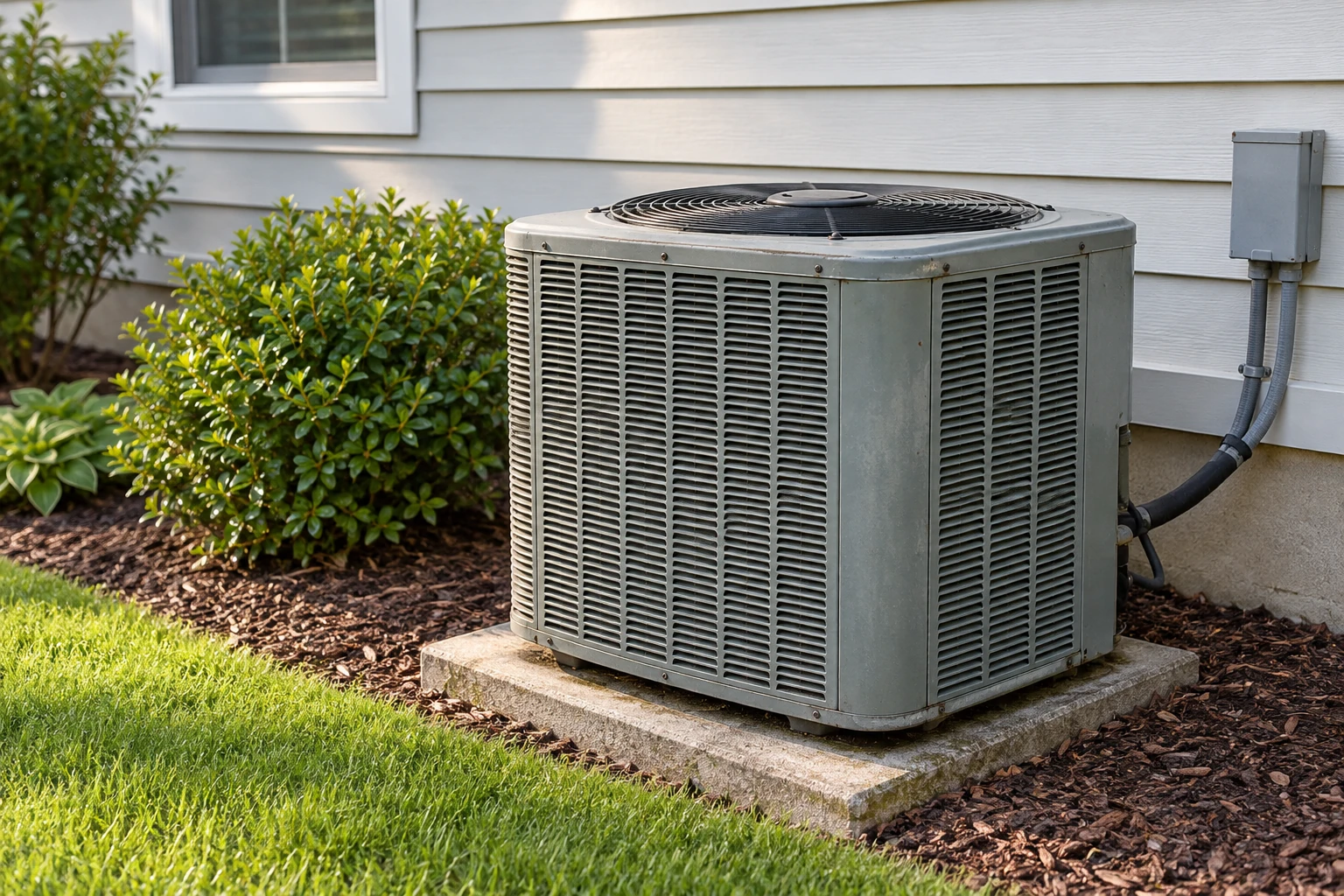
A central air conditioner's age is a planning clue, not an expiration date. Before deciding to replace it, establish when the equipment was installed, review its service history, and ask for a condition assessment. A working older system and a failing system of the same age do not necessarily justify the same decision.
This guide focuses on preparing for the end of a central AC system's useful life. It does not estimate repair prices, diagnose a failed compressor, or prescribe a replacement size. Those decisions need their own evidence. The useful outcome here is a written plan you can use before an emergency forces a rushed purchase.
What published lifespan estimates do and do not mean
Carrier's central AC lifespan guide gives a general 15–20-year estimate and explains that installation, maintenance, use, and climate affect actual life. Treat that as manufacturer guidance, not a guaranteed service life or a prediction for your unit. A warranty term is also not a promise that a system will fail when coverage ends.
ENERGY STAR lists an AC or heat pump older than 10 years as a reason to consider replacement, alongside issues such as recurring repairs or rising bills. “Consider” is the key distinction: that prompt for evaluation is not a requirement to discard a functioning system on a particular birthday.
These references answer different questions. A broad lifespan estimate describes an expectation; an evaluation threshold encourages planning. Neither replaces an inspection, and neither supports subtracting your equipment's age from a range to calculate guaranteed years remaining.
Establish the age of the actual equipment
Start with installation invoices, warranty records, inspection reports, or service documents. If you bought the home with the AC already installed, ask whether the sale documents identify an installation date. A home's construction year is not proof that the AC is the same age.
Record indoor and outdoor equipment separately. A previous owner may have replaced one component while keeping another. Do not assume that a recently replaced compressor makes every other part of the system new.
If paperwork is missing, photograph an exterior label only when it is safely accessible without opening anything or climbing. Ask the manufacturer or contractor to interpret the model and serial information. Avoid guessing an installation date from an unfamiliar serial-number format. Keep “unknown” in your record until you have reliable evidence.
Keep a condition history that survives the next service visit
A lifespan range cannot show whether the same fault recurred, a different component was repaired, or the home changed. Keep one dated history with separate indoor/outdoor equipment identities and links to the original records. Do not overwrite the earlier entry when a later provider gives a different explanation.
Give each event an evidence trail
For each event, retain its date; equipment/component identity; observation; professional finding; work authorized and completed; maintenance status; warranty decision; unresolved issue; and agreed follow-up. Distinguish installation date from manufacture date and keep an uncertain date labeled as uncertain. A major component replacement gets its own entry without resetting the age of unrelated equipment.
Comfort changes belong beside, not inside, the diagnosis. If energy use changes, retain consumption, billing period and relevant documented context such as occupancy, rate or weather information where available. A higher dollar bill by itself is not a measured loss of efficiency. Do not invent missing usage or attribute a change to age alone.
Read three entries without predicting the next failure
Hypothetical history, not a customer case:
- Installation entry: the invoice identifies an outdoor unit and retained indoor equipment. Their dates differ. The history keeps both identities and does not call the entire system new.
- Later service entry: the provider documents a repair and its scope. The record distinguishes the homeowner's complaint from the confirmed finding, notes the component actually changed, and attaches the coverage decision. Other components remain the same age.
- Subsequent comfort entry: the household reports a similar complaint, but the new provider's finding is not yet available. Mark it as a repeated symptom with diagnosis pending, not a proven repeat failure of the replaced component. An invoice saying only serviced does not close that gap.
Planning interpretation: the next conversation needs the earlier finding, completed scope and unresolved symptom. It may justify a focused follow-up assessment; it does not by itself select replacement. If the new finding instead concerns another component, preserve that distinction rather than counting every visit as the same failed repair.
Revisit the history for three different planning purposes
- Routine continuation: retain normal care and the next responsibility supported by the actual instructions or service finding.
- Unresolved or recurring concern: identify who will assess it, which evidence remains missing and whether any operating restriction was given. Immediate hazards take priority over completing this file.
- Future project planning: use the documented condition, component history, unresolved work and household plans to request realistic options before a rushed decision is necessary.
Carrier's lifespan discussion describes variable service life; this timeline supplies no years-remaining calculation. This page keeps the evolving HVAC history across visits and seasons. It does not turn one diagnosed fault into an automatic binary purchase decision.
Ask whether the complaint belongs to the equipment or the house
An uncomfortable room does not establish that the entire AC has reached the end of its life. ENERGY STAR notes that equipment operation, ducts, or insulation can contribute to uneven temperatures. Ask what was evaluated before accepting a recommendation that replaces equipment but leaves the original comfort complaint unexplained.
Likewise, a larger replacement is not a safe default answer. Our central AC sizing guide explains why the proposed system should be based on the home and a documented assessment rather than copying or increasing an old capacity.
If the current system is not cooling, get the immediate problem assessed. Do not turn this planning exercise into permission to keep operating damaged equipment. Leave cabinets closed; refrigerant, electrical, and internal mechanical diagnosis is professional work.
Hand off a diagnosed decision without turning the history into a formula
If a provider establishes a fault and proposes work, attach that finding and its unresolved limits to the timeline. The HVAC repair quote guide addresses the separate approval of competing repair and replacement scopes. For a confirmed compressor proposal, use the compressor scope and coverage guide.
Keep the dated history intact whichever option is chosen. A plan to retain the equipment needs its documented follow-up; a replacement creates a new equipment entry without erasing the former system's record. No age-times-cost rule, projected failure date or automatic replacement verdict is produced here.
Treat efficiency claims as a comparison to verify
A replacement proposal should identify the actual matched equipment and its documented ratings. Our SEER2 versus EER2 guide explains how to read those ratings without treating them as a household bill forecast.
Be careful with older buying advice. EPA states that the ENERGY STAR specification for central air conditioners was sunset on February 1, 2026. An older page's general advice to choose an ENERGY STAR central AC should not be treated as a current certification-shopping requirement. Ask for the proposed model's current documentation and applicable efficiency requirements. Heat pumps are a different product category; do not transfer a central-AC statement to every heating and cooling product.
This guide promises no payback period, percentage savings, rebate, or tax benefit. If those appear in a proposal, ask which current program or calculation supports them and verify eligibility before relying on the amount.
Make the plan useful even if you keep the AC
Keeping a system can be a deliberate decision. Save the condition assessment, follow the equipment's maintenance instructions, and record what change would trigger another review. That trigger might be a recurrence of the diagnosed problem or a new comfort complaint, not an invented date on which failure becomes certain.
If you are planning replacement, gather comparable scopes before you urgently need cooling. Keep a household plan for a cooling outage, particularly for people vulnerable to heat. Do not postpone a safety-related repair merely to wait for a preferred replacement season.
The decision file should leave you able to explain why you are repairing, monitoring, or replacing the system. “It is old” can start the discussion, but should not be the only evidence that ends it.
Common questions
Should every central AC be replaced at 10 years?
No. ENERGY STAR's age reference is a prompt to consider an evaluation. Condition, documented problems, and the proposed alternatives still matter.
Does reaching 20 years prove the system is unsafe?
Age alone does not establish a particular hazard. Conversely, a younger system is not automatically safe if it shows a fault. Have specific concerns assessed instead of treating a lifespan range as a safety test.
Can a contractor guarantee years remaining after a repair?
A repair scope and warranty should be clear, but a general lifespan article cannot guarantee the remaining life of unrelated components. Ask what the written coverage actually includes.
Should I replace a working unit only to lower bills?
Compare a documented proposal with your current situation and the assumptions behind any savings estimate. This guide provides no universal financial threshold and no guaranteed saving.