
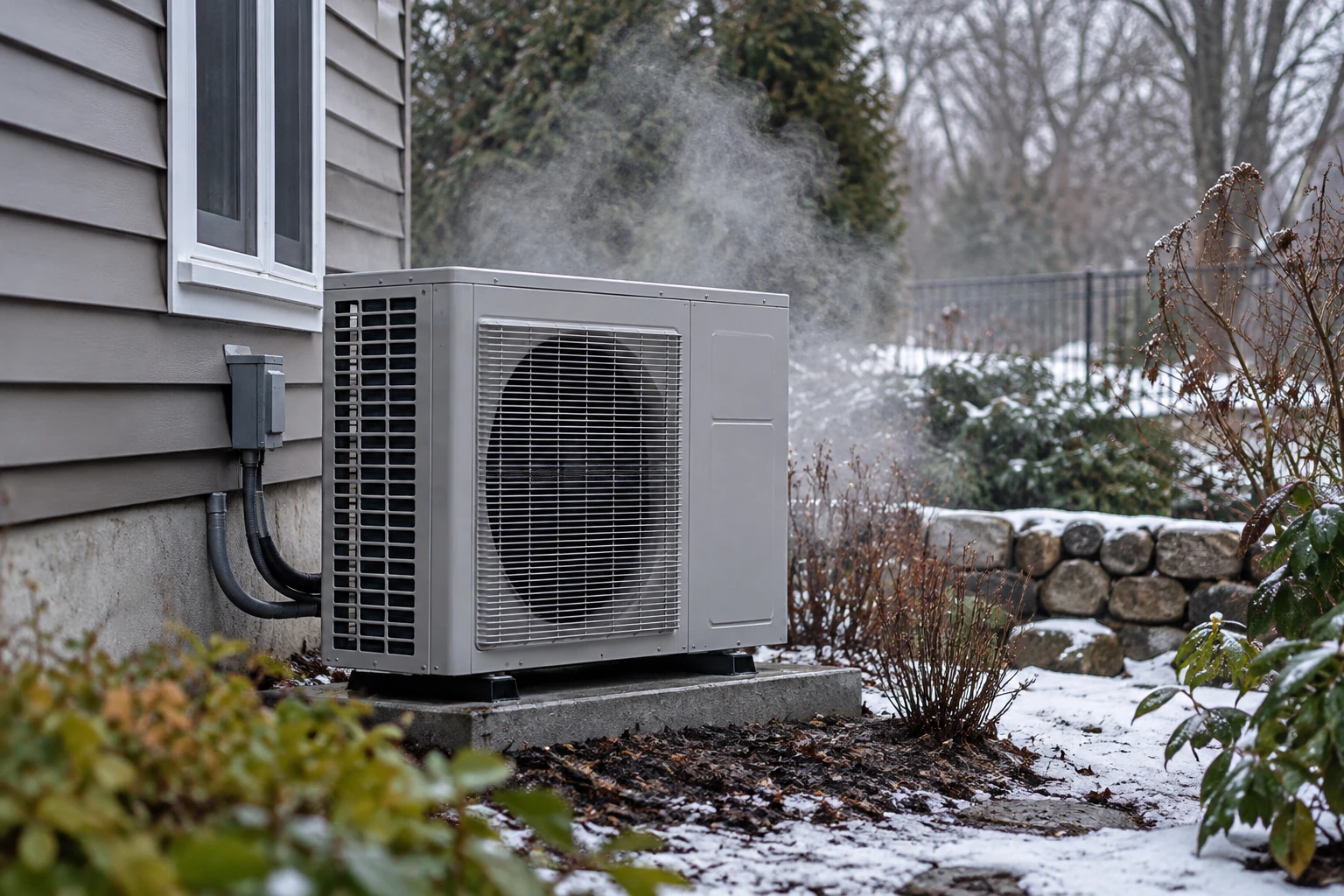
A cloud of white vapor beside a heat pump can be unsettling on a winter morning. In heating mode, however, an outdoor air-source heat pump can pause its usual operation to clear frost from its outdoor coil. The useful question is whether that brief change fits the equipment's documented defrost behavior and is followed by normal heating.
Observe from a safe location, keep the cabinet closed, and consult the owner's manual. Do not assume that every white cloud is harmless steam. Smoke, a burning odor, sparks, or an immediate safety concern requires a different response. This guide concerns outdoor heating-season defrost, not ice on an indoor AC coil during cooling.
Why the outdoor coil can develop frost
During heating, the outdoor portion of an air-source heat pump collects heat from outside air. The coil can become cold enough for moisture to frost on it. Defrost is the equipment's controlled process for clearing that accumulation. It is not a homeowner cleaning procedure.
Trane's explanation of the defrost cycle describes temporary changes that may include visible water vapor and an auxiliary-heat indication. The precise sequence depends on the system. Its examples should not become a universal timer or a promise that every unit will behave identically.
If you are uncertain whether the outdoor unit is a heat pump, check the equipment records or ask the service company. An outdoor cabinet alone does not establish its function. Our heat pump versus air conditioner guide explains that distinction without asking you to open equipment.
Look for a sequence, not one isolated sign
A useful record includes what the system was doing before the change, what you noticed, and whether normal heating returned afterward. A phone note made indoors is sufficient. Do not stand close to a fan opening or walk across ice to get a better view.
| Observation | Useful detail to record | Limit of the observation |
|---|---|---|
| White vapor outdoors | Whether it appeared during heating and then cleared | Appearance alone cannot rule out smoke |
| Change in sound or fan behavior | What changed and whether ordinary operation returned | Does not identify a failed part |
| Thermostat indication | Mode, displayed message, and any auxiliary-heat label | Does not prove the cause of the change |
| Outdoor frost | Whether a light coating cleared or accumulation persisted | A photograph does not establish refrigerant charge |
| Indoor comfort | Whether the home recovered or kept losing warmth | Does not establish a universal acceptable cycle length |
- Observation
- White vapor outdoors
- Useful detail to record
- Whether it appeared during heating and then cleared
- Limit of the observation
- Appearance alone cannot rule out smoke
- Observation
- Change in sound or fan behavior
- Useful detail to record
- What changed and whether ordinary operation returned
- Limit of the observation
- Does not identify a failed part
- Observation
- Thermostat indication
- Useful detail to record
- Mode, displayed message, and any auxiliary-heat label
- Limit of the observation
- Does not prove the cause of the change
- Observation
- Outdoor frost
- Useful detail to record
- Whether a light coating cleared or accumulation persisted
- Limit of the observation
- A photograph does not establish refrigerant charge
- Observation
- Indoor comfort
- Useful detail to record
- Whether the home recovered or kept losing warmth
- Limit of the observation
- Does not establish a universal acceptable cycle length
Record approximate start and finish times if you happen to observe them. Do not repeatedly raise the thermostat or force restarts to produce a sample. A sequence captured during ordinary operation is more useful than a test that changes several conditions at once.
When to arrange service
Contact a qualified HVAC provider when the pattern is new, heating does not recover, ice continues accumulating, or you are unsure whether the behavior matches the manual. Describe what happened rather than reporting that a particular sensor or valve must have failed.
Trane's heat-pump troubleshooting guidance distinguishes periodic frost from an outdoor unit that remains frozen. That distinction supports professional evaluation; it does not let a homeowner diagnose the cause from appearance. Heavy or persistent icing should not be dismissed simply because the unit has a defrost function.
A useful service message is: “The system was heating. I noticed vapor, recorded the time, and later saw that the ice had not cleared and the house was still cooling down.” Add any error message and the model number from an existing record. Avoid touching labels or components that require removing a panel.
If you see smoke or sparks, smell burning, or suspect a fire, move away and seek emergency help as appropriate. If the system appears abnormal but there is no immediate danger, use the normal thermostat control to stop operation if it is safe, then contact service. Do not repeatedly reset protective devices.
What you should not do to remove ice
Do not chip, scrape, or pry ice from the coil. Do not pour hot water on the unit, apply a heat gun, open a cabinet, force a defrost cycle, or change installer settings. Keep hands, tools, and covers away from the equipment. A damaged coil or an unsafe electrical situation is not a reasonable trade for clearing the visible frost.
Do not switch to emergency heat merely to experiment. The meaning and appropriate use of that control depend on the system. Ask the provider which ordinary user setting, if any, to use while waiting for service.
If snow or landscaping affects access, discuss a safe approach with the provider. The model-specific spacing discussion in our outdoor AC unit clearance guide is more appropriate than treating a photo or a generic distance as an installation requirement.
Keep defrost separate from other kinds of icing
Ice on an indoor coil while the system is cooling is a different situation. Use our frozen AC coil guide for that symptom. Do not keep cooling because you have heard that heat pumps “defrost themselves.” Heating-season outdoor defrost does not explain every icy component in every operating mode.
Likewise, a maintenance appointment is not a substitute for reporting a current loss of heat. For planned care, our heat pump maintenance guide helps organize owner tasks and professional visits. For an active problem, call with the observed pattern and ask how urgently the system should be assessed.
Questions to ask after the visit
Ask what was found, how it was confirmed, and which behavior is normal for your model. Request an explanation of any thermostat messages you are likely to see. If work was performed, keep the service description with the equipment records.
Before the technician leaves, clarify what should prompt another call: persistent ice, loss of heating, a repeated error, or a change from the explained sequence. You do not need a generic minute-by-minute rule when a model-specific explanation is available.
Is steam proof that defrost is working properly?
No. Water vapor can accompany defrost, but a single visible sign does not establish the condition of the whole system. Look for recovery and ask about anything unfamiliar.
Should I manually start defrost?
No. Leave service modes and internal controls to a qualified technician. Use only the ordinary controls described for homeowners in your manual.
Does every auxiliary-heat message mean a fault?
No. Its meaning depends on the operating conditions and system design. Record the indication and ask your provider to explain a persistent or unfamiliar pattern. Our guide to auxiliary heat versus Emergency Heat explains that separate control question.