
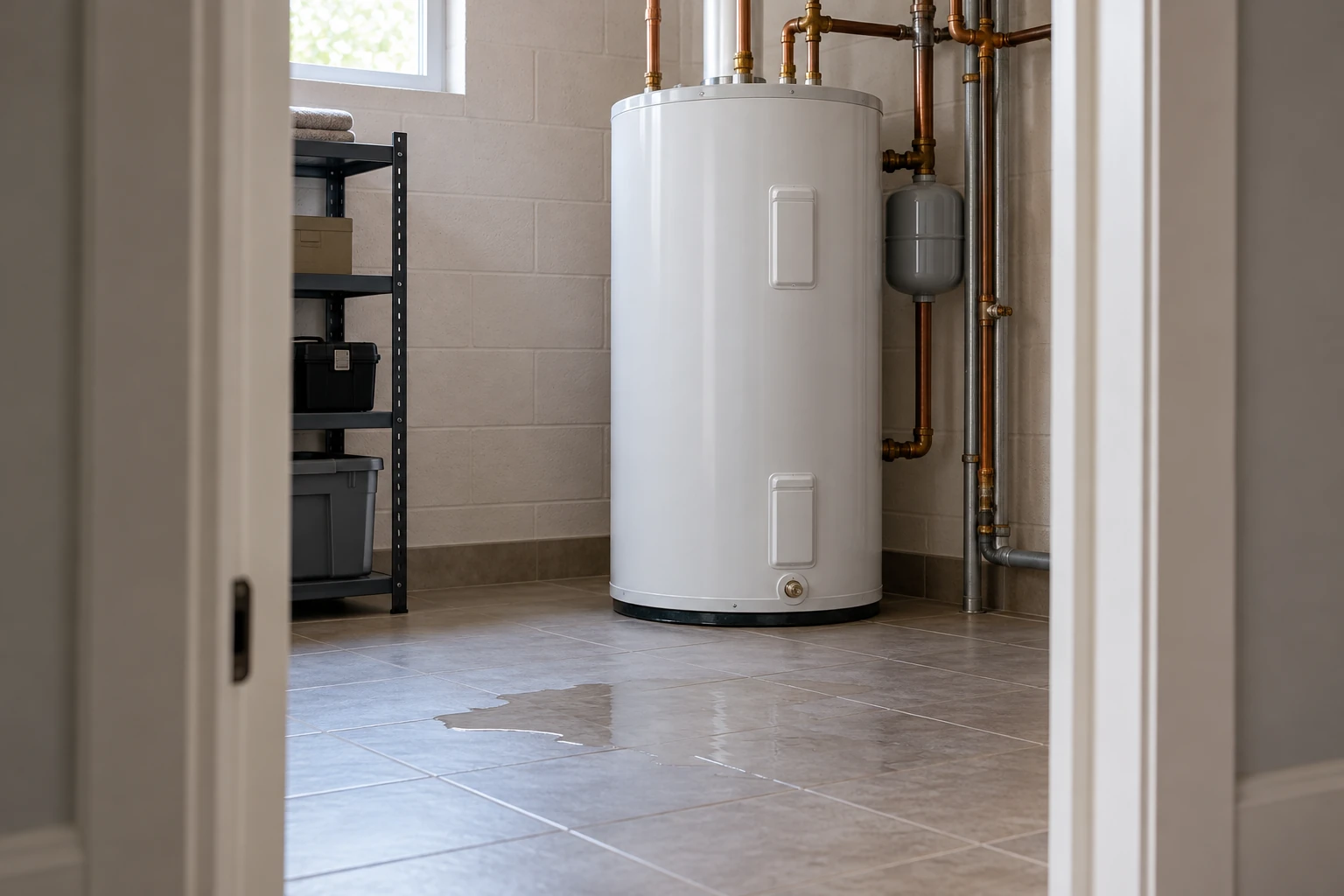
Water near a water heater needs attention, but a puddle does not identify its source or prove that the storage tank has failed. Start by keeping people away from hazards. A service report comes after immediate safety, not before it.
Do not approach the appliance through water, touch wet electrical equipment, or open a cabinet to locate a leak. If the area is unsafe or you cannot judge it from a safe position, leave it to qualified help. This guide covers observations and communication, not a leak-repair procedure.
Leave urgent hazards before collecting information
If you suspect a gas leak, leave the area and call the gas utility or emergency services from a safe location, as appropriate. Do not operate electrical switches or attempt to control the leak. SoCalGas gives this evacuation-first advice; its telephone numbers serve its own territory, so use the correct local emergency contact.
A carbon monoxide alarm, fire, smoke, or another immediate threat is not a reason to stay near the heater making notes. Leave and contact emergency services from safety. Do not assume the absence of a gas smell establishes safe air: CPSC describes CO as odorless and colorless.
Keep away from spraying hot water or a hot discharge. Keep children and pets out of the affected area. If water is near electrical equipment or blocks safe access, do not cross it to reach a switch, breaker, or valve. Tell the responder about that access problem rather than trying to solve it first.
Do not treat shutting something off as a required investigation
Stopping further use may be appropriate, but this guide cannot provide one shutdown sequence for every gas, electric, tankless, or heat-pump installation. Do not guess which valve or circuit controls the system, reach across water, or delay leaving a hazard to operate it.
If there is no immediate danger, describe the situation to the appropriate qualified provider and ask for instructions for your equipment. Follow only clearly applicable instructions that can be carried out safely from an accessible location. If access or the instruction is uncertain, say so and wait in safety; do not experiment with controls.
Do not restart equipment after water exposure simply to see whether it still heats. The A. O. Smith electric-equipment manual warns against operating equipment whose thermostat or surrounding insulation has been exposed to water and calls for qualified assessment. That model-specific warning supports caution; it is not a homeowner inspection procedure for another appliance.
Describe what is visible without naming the failed part
From a safe, normally accessible place, note when you first saw water and where it was already visible. Use existing observations rather than touching a pipe, reaching behind the unit, wiping an unknown discharge, or removing a cover to follow it.
| Observation already available | Useful way to report it | Do not conclude |
|---|---|---|
| Water on the floor | Location and whether the visible area appears to be spreading | The tank shell must have failed |
| Water near a pipe or discharge route | The visible location without approaching to trace it | A particular connection or valve needs replacement |
| A warning on an ordinary display | The message as seen safely, without opening controls | The warning identifies every affected component |
| Water after previous service | Date and what work the invoice records | The cause or responsibility is already established |
| Unsafe access | Water, heat, or another obstacle prevents approaching | You must cross the area to complete the report |
- Observation already available
- Water on the floor
- Useful way to report it
- Location and whether the visible area appears to be spreading
- Do not conclude
- The tank shell must have failed
- Observation already available
- Water near a pipe or discharge route
- Useful way to report it
- The visible location without approaching to trace it
- Do not conclude
- A particular connection or valve needs replacement
- Observation already available
- A warning on an ordinary display
- Useful way to report it
- The message as seen safely, without opening controls
- Do not conclude
- The warning identifies every affected component
- Observation already available
- Water after previous service
- Useful way to report it
- Date and what work the invoice records
- Do not conclude
- The cause or responsibility is already established
- Observation already available
- Unsafe access
- Useful way to report it
- Water, heat, or another obstacle prevents approaching
- Do not conclude
- You must cross the area to complete the report
A photograph can help only if it can be taken without entering the affected area or approaching hazards. Do not move closer for a label, remove personal items from unsafe water, or repeatedly run hot water to reproduce the event. A short description is enough to request help.
Keep different water sources as questions for the provider
Ask the professional to distinguish water from the appliance, connected plumbing, a safety-device discharge, condensate where applicable, or another nearby source. These are possible categories to assess, not a diagnosis you need to make yourself.
Heat-pump equipment can involve condensate handling, as described in PG&E's installation-planning resource. That does not make a puddle beside such a unit normal, harmless, or confirmed condensate. Report the water and have its source assessed rather than deciding that no service is needed.
If you already know water is coming from a temperature-and-pressure relief discharge, report it. Do not cap, plug, remove, or manipulate the device to stop the symptom. The manufacturer's safety warning identifies it as protective equipment requiring qualified attention. This guide does not instruct you to test its lever or select a replacement.
Arrange the right assessment and protect the record
Provide the model from an existing invoice or manual if you have it. If you do not, say that it is unknown. Include the observations already available, whether hot-water service changed, any previous work, and whether anyone can safely access the area.
Ask how urgently the company can assess the situation and whom to contact if conditions worsen. Tell it about immediate hazards before discussing an appointment. A routine booking should not replace an emergency response.
After the immediate situation is controlled, ask the provider to explain the finding and proposed scope in writing. A statement such as “the water heater is leaking” is less informative than a confirmed source and an explanation of the work proposed. If replacement is recommended, ask what evidence supports replacing the appliance rather than a different repair. For that replacement proposal, compare the complete installed scope.
Address affected materials without improvising a restoration job
The appliance assessment and any building-water-damage assessment may be separate tasks. Tell the appropriate provider or property representative about wet flooring, walls, ceilings, or other materials already observed. Do not assume correcting the equipment automatically resolves all effects of the water.
Keep service dates, photos taken safely, findings, and invoices together. Ask who will explain when the equipment can be used again and what follow-up remains. Do not use a dry-looking patch as your own clearance to restart equipment that may have been affected. Once safe operation has been confirmed, organize routine follow-up in a water heater maintenance plan.
Sources and safety scope
Sources checked October 20, 2026. The A. O. Smith manual is dated April 2011 and is cited for its explicit safety warnings, not current installation specifications. Gas and CO guidance is used within its emergency context. No cause, coverage decision, repair method, or safe-to-restart judgment is made remotely. The featured image is an original AI-generated illustration, not evidence of a diagnosed leak or a verified installation.