
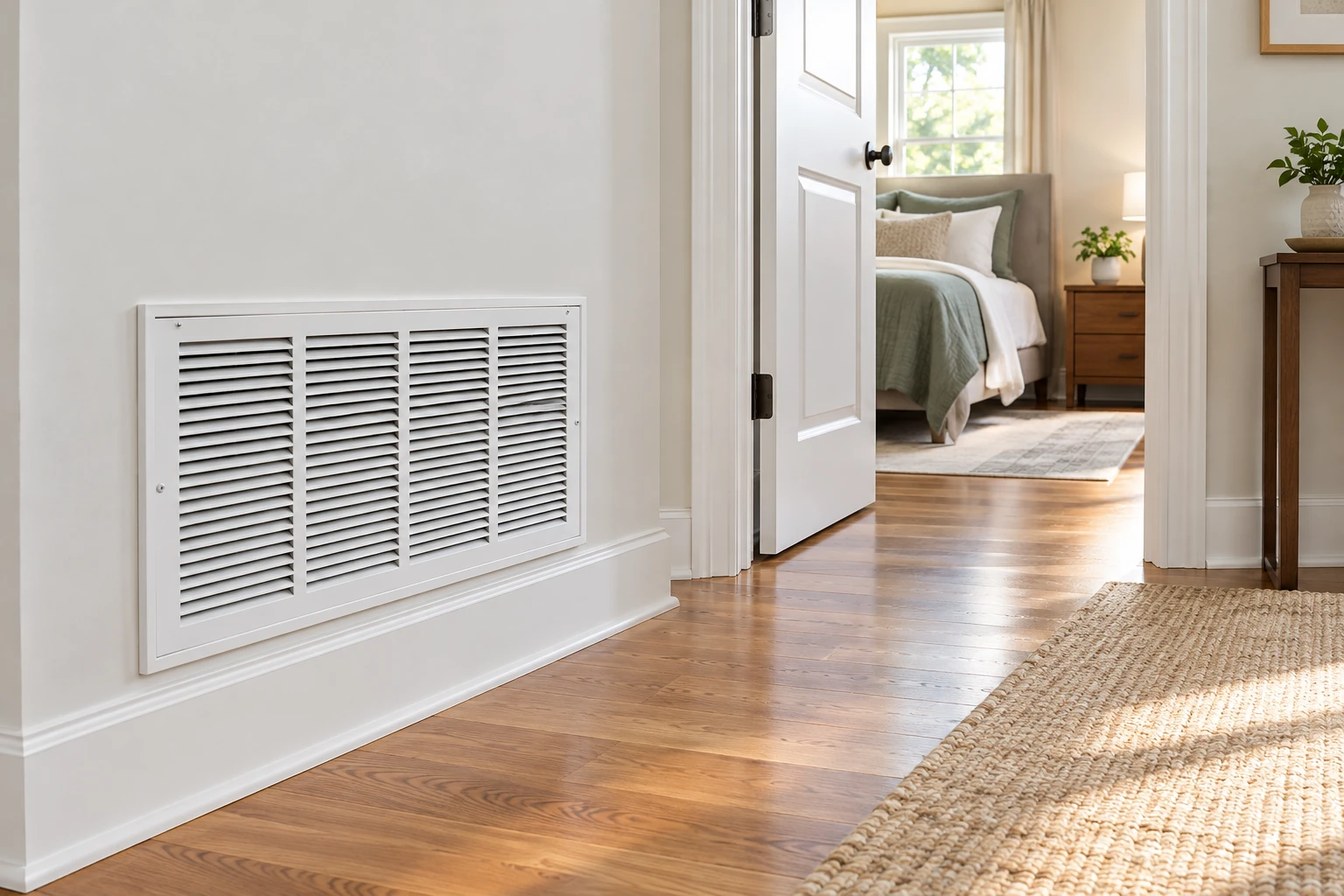
Return air vents are part of the path that brings indoor air back to a forced-air heating and cooling system. Keep known return grilles unobstructed and have persistent room-comfort problems assessed before changing ducts or cutting openings. A grille's size or location alone is not enough to identify every part of a home's air-distribution design.
This guide focuses on return-air paths, especially rooms separated from a central return by a door. It does not diagnose every cause of weak airflow, teach duct installation, or recommend duct cleaning as a universal solution.
Supply and return have different jobs
Supply outlets deliver conditioned air to rooms. Return paths allow air to travel back toward the system. The Building America Solution Center's airflow explanation describes how a closed interior door can separate a room's supply air from a central return and contribute to pressure imbalance.
That does not mean every bedroom needs a visible return grille or that every closed door causes a problem. Homes can have different designed pathways. If you do not know which grille is a return, consult the home's documentation or ask the service provider to identify it. Do not dismantle a grille or use smoke, a flame, or improvised tests to trace airflow.
A room that is uncomfortable with its door closed provides a useful observation, not a diagnosis. Solar exposure, insulation, supply delivery, and other conditions may also matter. Avoid jumping from a symptom to an instruction to add a return.
Start with ordinary obstructions
Look at the known return grilles from a normal standing position. Is a sofa, curtain, storage box, or decorative cover blocking one? Moving a loose household item away from an accessible grille is a reasonable first step. Do not create a trip hazard or move furniture you cannot handle safely.
Keep the entire grille available rather than leaving only a small visible strip. Do not cover a return to reduce noise, conceal it behind a cabinet, or tape a filter over it as an experiment. Ask about a grille that seems inconveniently placed before building furniture or remodeling around it.
If a filter is located at a return, use only the routine access and filter type specified for that system. Not every return contains a filter, and adding one is not automatically appropriate. Our MERV rating guide explains why filter compatibility matters. Do not remove service panels to search for another filter.
Record the door-related pattern
During ordinary use, note whether the same room feels different with its door open or closed. Record the time, which mode the system is using, and whether the complaint is temperature, noise, or a draft. You do not need to force repeated test cycles or leave doors in a position that conflicts with household safety or privacy.
If you already use a room thermometer, record readings under comparable conditions and explain where it was placed. Avoid treating a sunlit reading and a shaded reading as proof of a duct problem. Our thermostat-placement guide discusses how the location of a temperature reference affects observations.
The useful service request is specific: “This bedroom becomes uncomfortable during normal use with the door closed, while the hallway seems comfortable.” That is more informative than “the return is wrong,” which assumes the conclusion before measurements.
| What you notice | Safe next step | What not to conclude |
|---|---|---|
| Furniture covers a known return | Move the loose obstruction if safe | That this explains every system problem |
| One room changes with door position | Record the pattern during normal use | That cutting the door is the right repair |
| A grille is noisy | Describe when the sound occurs | That sealing the grille will solve it |
| A filter location is unclear | Check documentation or ask the provider | That every grille needs an added filter |
| Comfort remains uneven | Request an airflow and room assessment | That duct cleaning is automatically required |
- What you notice
- Furniture covers a known return
- Safe next step
- Move the loose obstruction if safe
- What not to conclude
- That this explains every system problem
- What you notice
- One room changes with door position
- Safe next step
- Record the pattern during normal use
- What not to conclude
- That cutting the door is the right repair
- What you notice
- A grille is noisy
- Safe next step
- Describe when the sound occurs
- What not to conclude
- That sealing the grille will solve it
- What you notice
- A filter location is unclear
- Safe next step
- Check documentation or ask the provider
- What not to conclude
- That every grille needs an added filter
- What you notice
- Comfort remains uneven
- Safe next step
- Request an airflow and room assessment
- What not to conclude
- That duct cleaning is automatically required
What a professional return-path assessment can include
PNNL's ducted-return guidance describes investigating room pressure differences and whether air has an adequate route back to the air handler. Individual returns, transfer grilles, jump ducts, and other designed paths may be relevant. The appropriate choice depends on the home; a photograph or a gap under one door does not establish adequate capacity.
Ask the contractor to explain what was measured, whether the complaint was reproduced, and how the proposed change addresses the finding. If door position is central to the complaint, ask whether the assessment considered that condition rather than only testing with every room open.
PNNL's transfer-grille guidance explains one way to connect a closed room with an adjacent space. It is technical design guidance, not an instruction to cut a hole in your wall. A proposal should account for the actual building and relevant requirements, not copy an opening size from a different installation.
Do not cut doors, walls, ceilings, or ducts, install a booster fan, or alter dampers based on this article. Hidden wiring, piping, structural elements, and the building's separation requirements need appropriate professional consideration. Do not enter an unsafe attic or crawlspace to trace a suspected pathway.
Separate return problems from leakage and cleaning
An inadequate route out of a closed room is a different question from a leaking duct or debris inside ductwork. The solutions should follow the findings. Our duct sealing versus duct cleaning guide explains why those services are not interchangeable.
Avoid approving a package simply because it promises “better airflow.” Ask which problem has been established, what work is included, and how the result will be checked. If a proposal adds a return, ask where it connects and what assessment supports the design. If it calls for cleaning, ask for the separate reason cleaning is warranted.
Similarly, an uncomfortable room is not, by itself, proof that the AC must be larger. Our central AC sizing guide addresses the evidence behind replacement capacity. Resolve the room and air-distribution questions before assuming new equipment will correct them.
Plan furniture and remodeling around known air paths
Before placing a tall cabinet, installing built-ins, or changing a door, identify any supply and return openings affected by the project. Give the HVAC professional a simple sketch and photographs taken safely from the room. Ask whether the proposed change preserves the designed path and service access.
Do not let a decorative cover become an unreviewed system modification. If an existing grille is damaged or unattractive, ask about a suitable replacement rather than choosing solely by exterior dimensions. Keep any approved specifications with the project records.
After a professional change, request a clear explanation of the result and what to watch for. Note whether the original complaint improved during normal use. If it did not, report that directly rather than making another adjustment yourself.
When ordinary observation is not enough
Persistent temperature differences, unusual noise, or a suspected hidden obstruction deserve a service assessment. Stay away from damaged electrical equipment or water near it. Do not continue a comfort experiment if the system is repeatedly shutting down, icing, or showing another abnormal condition.
This guide covers accessible room observations only. It does not establish indoor-air quality, mold presence, safe combustion, or the condition of concealed ductwork. Those questions need appropriate assessment rather than an inference from how a grille looks.
Common questions
Does every bedroom need its own return vent?
Not necessarily. Different designs provide return paths in different ways. Ask whether the actual room has an adequate path under the conditions in which you use it.
Can I cut the bottom of a door to fix the problem?
Do not make that change based on a general article. The required pathway and the consequences of altering the door need assessment; a visible gap is not proof of performance.
Should I close other vents to push more air into the room?
Do not use widespread vent closure as a substitute for diagnosis. Describe the room-specific complaint and have the distribution system assessed before altering its intended operation.
Is a large wall grille definitely a return?
Appearance is a clue, not confirmation for every home. Check documentation or ask the provider to identify the grilles and any owner-accessible filters.