
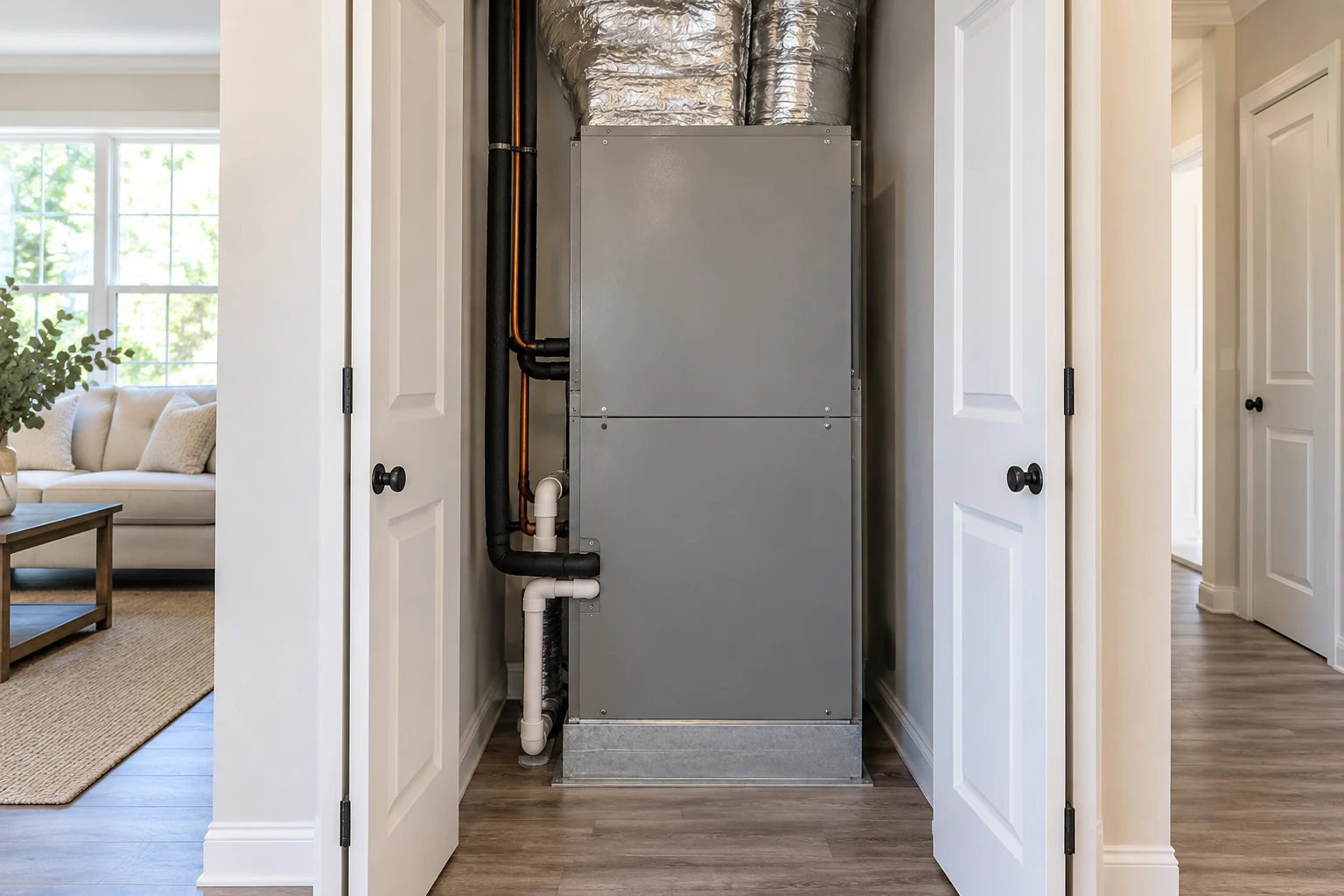
An HVAC air handler is the indoor assembly that moves air in many ducted heating and cooling systems. Identifying that role helps you understand a service report: the indoor air handler and outdoor unit can be separate pieces of one system, rather than two competing names for the same appliance.
You can understand the arrangement from existing manuals and installation paperwork. There is no reason to open a cabinet, enter an attic or crawl space, or approach wiring to identify it.
Follow the air, not just the equipment name
For a typical ducted arrangement, the useful concept map is rooms → return path → indoor equipment → supply ducts → rooms. This describes functions, not a route to inspect inside equipment.
Carrier's air-handler explanation describes indoor air returning through ducts, filtration, heating or cooling at the indoor equipment, and distribution by the blower. Exact component order and filter location depend on the installation. The map does not show every possible configuration.
The return side brings room air back. The supply side delivers conditioned air. That circulation alone does not establish a fresh-air supply from outdoors; ventilation is a separate question.
Four terms that describe different things
| Term on a document | What it identifies | What the term alone does not establish |
|---|---|---|
| Air handler | An indoor equipment assembly that circulates and conditions air | The outdoor unit's model, capacity, or compatibility |
| Blower | The air-moving component, rather than the whole system | Whether the surrounding equipment is a furnace or an air handler |
| Indoor coil | A heat-transfer component associated with the indoor side | That every indoor cabinet has the same layout or heating equipment |
| Outdoor unit | A separate part of many split systems | Whether it is an AC-only unit or a heat pump |
- Term on a document
- Air handler
- What it identifies
- An indoor equipment assembly that circulates and conditions air
- What the term alone does not establish
- The outdoor unit's model, capacity, or compatibility
- Term on a document
- Blower
- What it identifies
- The air-moving component, rather than the whole system
- What the term alone does not establish
- Whether the surrounding equipment is a furnace or an air handler
- Term on a document
- Indoor coil
- What it identifies
- A heat-transfer component associated with the indoor side
- What the term alone does not establish
- That every indoor cabinet has the same layout or heating equipment
- Term on a document
- Outdoor unit
- What it identifies
- A separate part of many split systems
- What the term alone does not establish
- Whether it is an AC-only unit or a heat pump
Trane describes air handlers working with heat pumps or air conditioners. Its product terminology and feature descriptions are examples, not proof that your home's equipment has those features.
An indoor cabinet is not automatically a furnace
Carrier distinguishes a furnace, which supplies heat through combustion in a gas configuration, from an air-handler arrangement that can use a coil and electric heating equipment. Both arrangements can involve a blower. Hearing “blower motor” in a repair proposal therefore does not identify the entire indoor appliance.
A split heat-pump system may have an air handler indoors and the heat pump outdoors. Another home's cooling equipment may share the blower associated with a furnace. These examples explain why a photograph of the outside cabinet or the thermostat's brand is insufficient to identify the complete system.
For the equipment-choice distinction, see heat pump versus air conditioner. This page concerns the indoor component's role, not which technology you should buy.
Translate a service statement into a system relationship
Consider a hypothetical report: “Replace the indoor blower; existing outdoor equipment remains.” That describes work on an indoor component. It does not, by itself, mean replacement of the complete HVAC system, a new indoor coil, or a change in outdoor capacity.
By contrast, “replace indoor and outdoor equipment as a matched system” describes a broader proposal. The useful clarification is which assemblies and components the scope includes, and how the provider established compatibility. Do not compare those proposals as though they purchase the same work.
Likewise, “variable speed” describes a capability, not a guarantee that every room will have equal temperature. Ask how the actual equipment and duct arrangement support the proposed operation. A product feature is not a substitute for a site assessment.
Identify it without opening it
Use a prior invoice or manual to locate the indoor model designation and the separate outdoor designation. If paperwork says only “HVAC unit,” leave the indoor type unknown until the provider identifies it. A label already readable from a safe, ordinary location may help; inaccessible information can wait for the visit.
Keep component findings separate from symptoms. Weak airflow, water near equipment, or a comfort change does not prove an air-handler failure. Our guides to filter compatibility and condensate problems address those narrower situations without authorizing internal service.
What a replacement proposal still needs
An indoor model number is a starting point, not a sizing calculation. Before accepting a replacement scope, establish what stays, what changes, and which compatibility and capacity assessment supports that combination. Central AC sizing explains the separate replacement-planning question.
Electrical testing, blower work, coil service, refrigerant work, and internal adjustments belong to qualified professionals. The homeowner's useful role here is to understand which part of the system a document actually describes.
Sources checked October 21, 2026: Carrier and Trane manufacturer explanations linked above. The concept map and proposal examples are editorial interpretation, not an inspection or diagnosis of your home.