
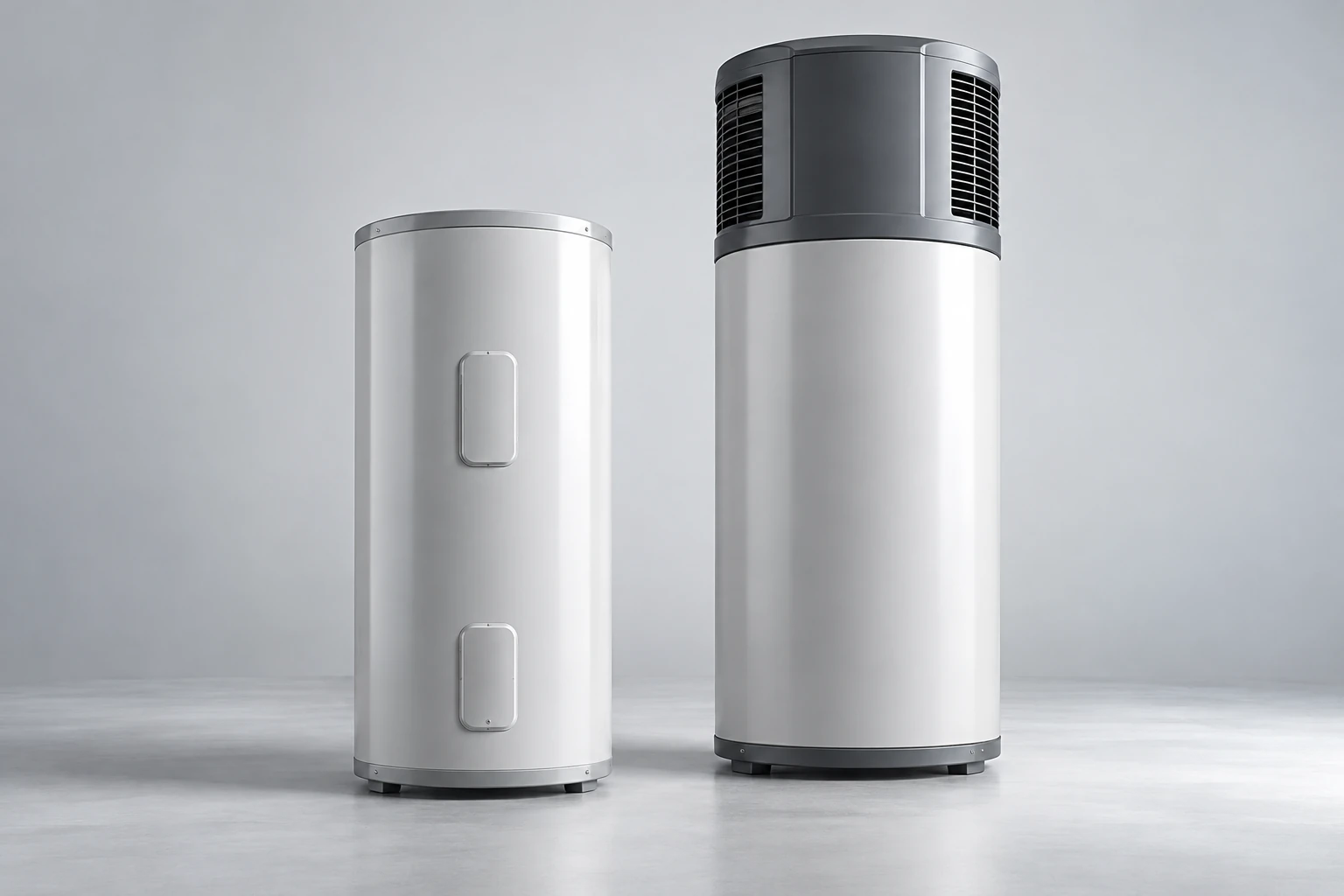
The main difference is how heat reaches the water: electric resistance generates heat with elements, while a heat-pump water heater moves heat from surrounding air. That difference changes the installation and operating questions, not just the efficiency label. Compare two complete proposals against the same household demand rather than declaring a winner from the word “hybrid.”
This comparison covers integrated storage equipment. It is separate from the heat pump versus air conditioner decision for heating and cooling rooms.
What changes when water heating uses surrounding air?
ENERGY STAR's explanation describes heat transfer into the stored water and resistance operation available in hybrid products. The control strategy matters: heat-pump operation, combined operation and resistance-only operation are not the same energy-use assumption. Mode names and behavior must be confirmed for the specific model.
Resistance equipment does not need a heat-pump air source. A heat-pump option introduces air, condensate and sound considerations alongside the storage tank. That is why a same-location replacement and a technology change can involve different work even when both proposals say “electric.”
Compare trade-offs before comparing prices
| Decision factor | Electric-resistance storage proposal | Integrated heat-pump proposal |
|---|---|---|
| Heating method | Identify the actual resistance model | Identify the heat-pump model and any resistance backup |
| Proposed location | Confirm fit, service access and applicable installation needs | Also resolve the air source, environmental suitability, condensate and sound implications |
| Household demand | Show delivery capability for the stated use pattern | Show delivery capability and the operating mode assumed for that demand |
| After a busy hot-water period | Identify the model's recovery information | Explain recovery in the proposed normal mode and when backup may operate; do not assume identical behavior |
| Energy comparison | Obtain comparable label information and local assumptions | Separate the heat-pump benefit from assumptions about backup use and surroundings |
| Installed scope | List included removal, connections and required changes | Identify any additional location, drainage or other project work explicitly |
| Ongoing care | Use the actual owner instructions | Include applicable air-side and condensate care as well as tank-related care |
- Decision factor
- Heating method
- Electric-resistance storage proposal
- Identify the actual resistance model
- Integrated heat-pump proposal
- Identify the heat-pump model and any resistance backup
- Decision factor
- Proposed location
- Electric-resistance storage proposal
- Confirm fit, service access and applicable installation needs
- Integrated heat-pump proposal
- Also resolve the air source, environmental suitability, condensate and sound implications
- Decision factor
- Household demand
- Electric-resistance storage proposal
- Show delivery capability for the stated use pattern
- Integrated heat-pump proposal
- Show delivery capability and the operating mode assumed for that demand
- Decision factor
- After a busy hot-water period
- Electric-resistance storage proposal
- Identify the model's recovery information
- Integrated heat-pump proposal
- Explain recovery in the proposed normal mode and when backup may operate; do not assume identical behavior
- Decision factor
- Energy comparison
- Electric-resistance storage proposal
- Obtain comparable label information and local assumptions
- Integrated heat-pump proposal
- Separate the heat-pump benefit from assumptions about backup use and surroundings
- Decision factor
- Installed scope
- Electric-resistance storage proposal
- List included removal, connections and required changes
- Integrated heat-pump proposal
- Identify any additional location, drainage or other project work explicitly
- Decision factor
- Ongoing care
- Electric-resistance storage proposal
- Use the actual owner instructions
- Integrated heat-pump proposal
- Include applicable air-side and condensate care as well as tank-related care
The matrix is an editorial comparison framework, not a design specification. Neither column establishes required room dimensions, circuit suitability, a recovery time or a maintenance interval.
A useful proposal comparison keeps unknowns visible
Hypothetical example, not a customer installation: Offer A specifies electric-resistance storage in the existing location and includes removal and installation. Offer B specifies a heat-pump model, gives a lower estimated annual energy cost, and says drainage will be “confirmed on site.” Both are intended to serve the same morning routine.
Offer B's estimate does not yet make it the complete lower-cost choice. Its unresolved drainage and location scope need to be defined before comparing installed totals. Offer A's familiar technology does not establish that its delivery recommendation meets the household either. Both proposals still need a capacity explanation tied to the same use pattern.
The practical next step is to obtain the missing project details, then compare the offers again. This example does not conclude that the heat-pump option is unsuitable or that resistance is cheaper. It shows why an incomplete scope cannot be treated as an equal offer.
Read energy estimates as estimates
The FTC explains that EnergyGuide operating cost uses typical consumption and a national average energy price. Actual cost depends on local prices and use. Keep label comparison separate from a home-specific bill forecast.
For a proposal's forecast, identify the energy rate, usage assumption, exact model and operating mode. If a payback figure appears, check whether its initial-cost difference includes all necessary work. Do not use a brochure's savings example to fill an unresolved installation allowance.
Our water heater energy-label guide explains the label side of this comparison. No savings percentage, incentive, tax credit or payback guarantee is claimed here.
Decide in this order
- Establish whether each exact-model installation is suitable for the proposed location. The placement guide helps evaluate whether that assessment is documented.
- Compare hot-water delivery requirements against the same household pattern, including busy periods and normal operating assumptions.
- Compare the complete replacement scopes, exclusions and unresolved costs.
- Weigh estimated running costs and ordinary use only after those foundations are clear.
For someone with limited installation space, location evidence may settle the shortlist before a savings estimate matters. For someone with two feasible documented options, operating cost and preferences may decide. Those are different decisions, so there is no universal winner.
Leave electrical, plumbing and equipment alterations to qualified professionals. Do not open covers or modify air paths to make an option fit. At handover, obtain the model's operating instructions and maintenance responsibilities.
Sources reviewed October 21, 2026. The comparison and hypothetical example are editorial decision aids, not product tests. The existing AI-generated featured illustration does not depict a verified installation.