
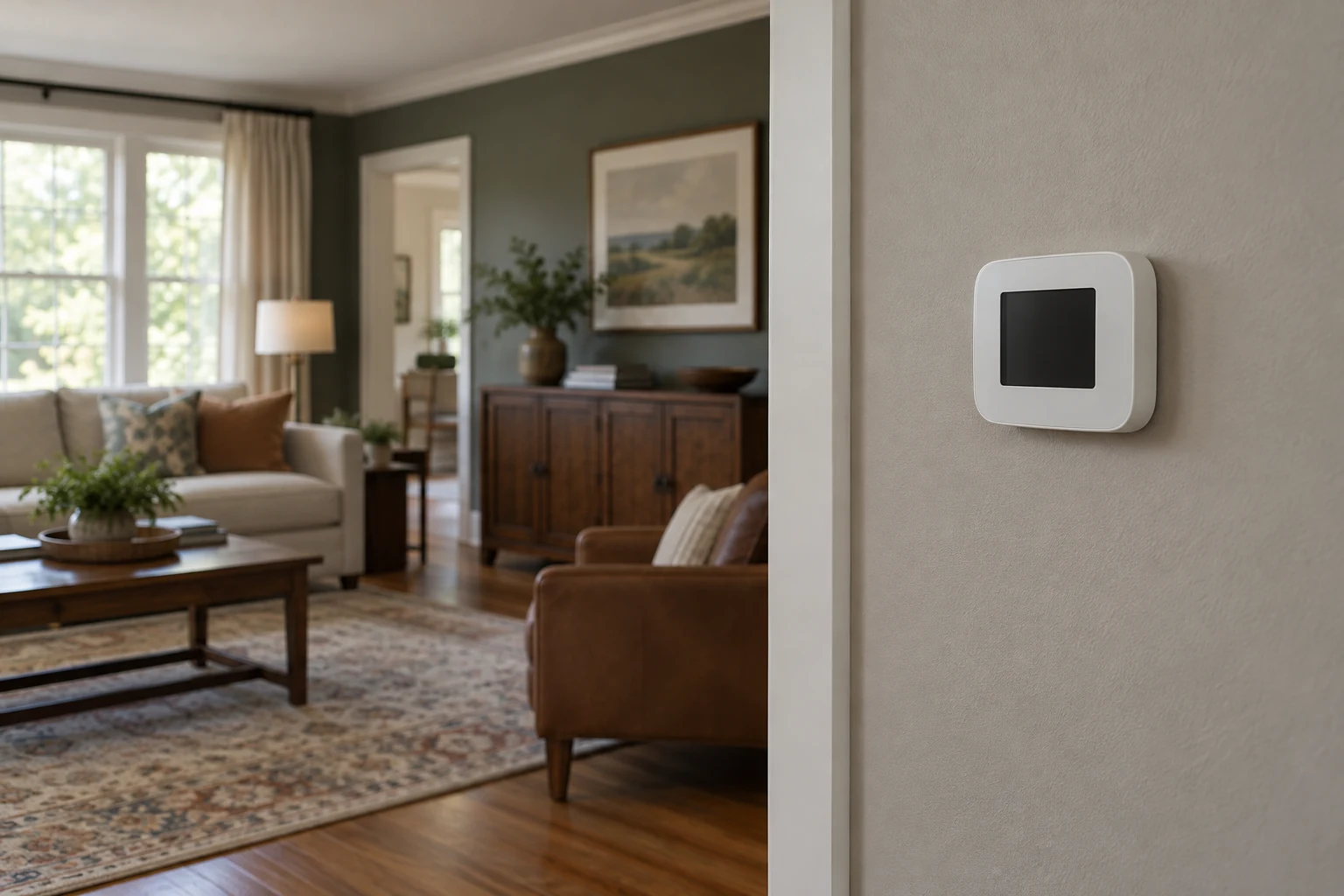
A thermostat in the wrong spot can make a comfortable room and the displayed temperature seem unrelated. Before paying to move it, identify where the system is actually sensing temperature, what happens around that location, and which rooms you want a technician to assess. A different wall is a possible solution, not a diagnosis.
This guide is about thermostat placement in a home with central heating and cooling. It does not provide wiring or relocation instructions. If your immediate problem is an AC that has stopped cooling, start with our safe cooling checks and stop conditions.
What makes a useful thermostat location?
Lennox recommends an interior wall in a central area, away from direct sun, windows, vents, and heat-producing appliances. The purpose is to avoid a localized influence dominating the temperature reading. Its guidance also recommends professional relocation because moving the control involves wiring.
Treat that as a starting point for a home-specific assessment. “Central” should not simply mean the geometric middle of a floor plan. Ask whether the location represents the occupied area served by that control. A hallway, for example, deserves evaluation rather than an automatic pass or fail.
Do not choose a mounting height or new wall from a generic online rule alone. Ask the installer to check the exact model's instructions, accessibility, existing system, and proposed location before agreeing to the work.
First, identify the active temperature reference
Write down the thermostat model from its normal app, paperwork, or externally visible label. Do not remove it from the wall to find a model number. If the normal display or app identifies an active remote sensor, note its name and room. If that information is unclear, leave it as a question for the technician.
Google's Nest sensor documentation illustrates why this matters: supported models can use a separate sensor's room temperature for control. Compatibility and behavior are model-specific. A remote sensor is not automatically compatible with every smart thermostat.
Your appointment request should distinguish “the wall thermostat is in the hall” from “the system is currently controlling to the bedroom sensor.” Otherwise, a discussion about moving the wall unit may start with the wrong reference point.
Make an observation note, not a DIY diagnosis
Use normal household conditions. Do not intentionally heat, cool, cover, or blow air at the thermostat to test it. Record the conditions when the comfort issue naturally occurs, then compare with a time when the same room feels comfortable.
| Record | Useful detail | Avoid concluding |
|---|---|---|
| Time and room | Which occupied room feels uncomfortable and when | That one observation proves a bad location |
| Display and target | The displayed temperature, target, and active sensor if shown | That the target is a measurement of every room |
| Nearby conditions | Sun on the wall, a nearby appliance in use, or an exterior door opening | That a nearby object must be the sole cause |
| Household pattern | Which rooms are occupied and which doors are normally open | That changing every door position will solve the problem |
| Recent change | New furniture, a different room use, or a control setting change | That the thermostat itself needs replacement |
- Record
- Time and room
- Useful detail
- Which occupied room feels uncomfortable and when
- Avoid concluding
- That one observation proves a bad location
- Record
- Display and target
- Useful detail
- The displayed temperature, target, and active sensor if shown
- Avoid concluding
- That the target is a measurement of every room
- Record
- Nearby conditions
- Useful detail
- Sun on the wall, a nearby appliance in use, or an exterior door opening
- Avoid concluding
- That a nearby object must be the sole cause
- Record
- Household pattern
- Useful detail
- Which rooms are occupied and which doors are normally open
- Avoid concluding
- That changing every door position will solve the problem
- Record
- Recent change
- Useful detail
- New furniture, a different room use, or a control setting change
- Avoid concluding
- That the thermostat itself needs replacement
If you already use a separate room thermometer, include its location and reading as another observation. Do not present an informal comparison as a calibrated test or use it to change installer calibration settings. The professional can decide whether measurements need checking under controlled conditions.
Photos can make the discussion easier: one of the closed thermostat and one showing the surrounding wall and room. Keep people, account details, and personal information out of photos sent to a contractor. There is no need to open equipment or photograph wiring.
Separate a placement question from a scheduling question
Placement asks where the control senses conditions. Scheduling asks what temperature target is requested at a particular time. Bring both pieces of information to the appointment, but avoid changing several settings while trying to document one recurring problem.
If the room is uncomfortable because the programmed target does not match when people use it, our summer thermostat schedule guide addresses that separate decision. A request to move the thermostat should explain what remains wrong under the household's intended schedule.
Could a remote sensor help instead of relocation?
Ask about a compatible sensor as an option, not as a guaranteed fix. Google cautions that controlling to one room can leave other rooms warmer or cooler, and that sensor placement can affect energy use. Its guidance keeps sensors away from sun, heat sources, and enclosed spots and within the area controlled by the associated thermostat. Those are product-specific instructions, not a promise of whole-home balance.
Before buying anything, request answers to these questions:
- Does this exact thermostat support the proposed sensor?
- Will it monitor temperature only, become the active reference, or participate in another control strategy?
- How will everyone in the household know which reference is active?
- Which rooms will be checked when evaluating the result?
- What will the contractor investigate if the original complaint remains?
Do not accept a sensor as evidence that the underlying system has been assessed. Likewise, do not assume that moving the thermostat is equivalent to creating independently controlled rooms.
What to ask before approving a thermostat move
Request a written scope that distinguishes assessment from installation. It should identify the proposed location, control model, any sensor arrangement, wiring work, wall repair responsibility, and how operation will be checked afterward. Ask which parts of the job are included and which require a separate trade or visit.
A useful question is: “What evidence makes relocation appropriate for this complaint, and what would make you recommend a different investigation?” That keeps the conversation tied to the problem rather than a preferred product.
Use our contractor selection and service-visit preparation guide for the broader hiring process. This article does not estimate relocation prices or recommend a new HVAC system based on a thermostat symptom.
Keep the assessment homeowner-safe
Limit your role to normal controls, visible surroundings, and notes. Leave removal, wiring, drilling, electrical testing, and installer-menu adjustments to a qualified professional. A thermostat that looks simple does not establish what electrical system is behind it. For a blank thermostat screen, use the separate display guide rather than treating it as a placement problem.
If the complaint involves a burning smell, smoke, water near electrical equipment, or another immediate hazard, stop the location assessment and seek appropriate urgent assistance. Comfort troubleshooting should not delay a safety response.
Bring a clear question to the appointment
A concise service note can say: “The living room feels too warm in the late afternoon. The control is on the hall wall; the app shows that control as active. Here are the normal target, displayed reading, and photos. Please assess whether the sensing location contributes before proposing a move.”
Use your own observations rather than copying that example as a diagnosis. The goal is a justified decision about the temperature reference, with a defined follow-up if the comfort problem persists.
Sources
- Lennox: Finding the right thermostat location — manufacturer guidance published June 26, 2026.
- Google Nest: Temperature sensor placement and operation — documentation for the supported models listed on that page.
Sources checked October 17, 2026. This is homeowner education, not a wiring guide or an assessment of a particular installation.