
A home can feel cool and still feel damp. Before lowering the thermostat again or buying a dehumidifier, separate three questions: what is the humidity reading, where is the moisture showing up, and is there an identifiable water source? Those answers help you choose the next step without assuming that the air conditioner needs a repair.
This guide is for U.S. homeowners dealing with summertime indoor humidity. It covers measurement, everyday moisture sources, and questions about professional assessment or dehumidification. It does not diagnose an HVAC fault, size equipment remotely, or explain mold cleanup.
Use a Humidity Reading Alongside the Temperature
Relative humidity, usually shown as RH, expresses moisture in the air relative to saturation at that temperature. Temperature and RH belong together in your notes; an RH number is not a direct measurement of how much water entered the home. ENERGY STAR explains relative humidity and humidity controls.
EPA recommends keeping indoor RH below 60%, ideally between 30% and 50% if possible. Use that as moisture-control guidance, not a guarantee that every surface is dry or that a building has no mold. A room reading cannot settle whether a hidden area has a water problem.
A hygrometer or humidity meter gives you something more useful to record than “it feels sticky.” Follow its placement and reading instructions, including any settling time after moving it. Note whether a number comes from a room meter, thermostat, or dehumidifier display. Do not silently combine different devices into one trend.
This is a summer guide. Do not transfer a summer target to every winter condition or treat the top of the range as the setting every home should use. Equipment instructions and the conditions in your building still matter.
Build a Useful Record Without Delaying a Water Problem
For recurring discomfort without an immediate hazard, record readings at comparable times and locations. Include a reading when the complaint is noticeable rather than checking only when the room feels comfortable. The point is to describe a pattern, not to collect a prescribed number of days before seeking help.
| Record | Useful detail |
|---|---|
| Date and time | When the reading was taken, including whether it followed a shower, cooking, or another activity |
| Room and device | The room, meter used, and whether the meter was recently moved |
| Temperature and RH | Both readings as displayed; do not invent a missing temperature |
| Cooling context | Thermostat setting and whether cooling was operating when you checked |
| Moisture observations | Visible condensation, a damp patch, or an odor, described without naming an unconfirmed cause |
| Conditions changed | Windows open, exhaust fan used, or another ordinary change you know occurred |
- Record
- Date and time
- Useful detail
- When the reading was taken, including whether it followed a shower, cooking, or another activity
- Record
- Room and device
- Useful detail
- The room, meter used, and whether the meter was recently moved
- Record
- Temperature and RH
- Useful detail
- Both readings as displayed; do not invent a missing temperature
- Record
- Cooling context
- Useful detail
- Thermostat setting and whether cooling was operating when you checked
- Record
- Moisture observations
- Useful detail
- Visible condensation, a damp patch, or an odor, described without naming an unconfirmed cause
- Record
- Conditions changed
- Useful detail
- Windows open, exhaust fan used, or another ordinary change you know occurred
Keep the first observation separate from your interpretation. “Water appeared below this window after rain” is useful evidence. “The AC is oversized” is a diagnosis that the note cannot establish.
If two meters disagree, record the disagreement. Check their instructions and ask about accuracy or placement before treating the difference as a building problem. A single unexpected value should prompt a sensible check, not an automatic equipment purchase.
Do not wait to complete a log when there is a leak, wet building material, or suspected contamination. EPA emphasizes prompt action on water problems. If you know or suspect the HVAC system is contaminated with mold, EPA advises not running it because it may spread contamination; obtain qualified guidance. Keep out of areas with water near electrical equipment and seek appropriate help. EPA homeowner mold and moisture guidance.
Separate Everyday Moisture From a Building Leak
Cooking, showers, and some appliances can add moisture indoors. EPA's humidity lesson describes these sources. Start with observations available in ordinary living areas: whether the complaint follows a particular activity, affects one room, or appears throughout the house.
Use existing kitchen and bathroom exhaust systems as intended, and follow their instructions. Do not assume a fan removes moisture outdoors just because it makes noise; ask for assessment if its performance or venting is uncertain. You do not need to climb onto the roof or inspect hidden ducts to report that uncertainty.
Opening windows is not a universal summer solution. EPA distinguishes ventilation with cold, dry outdoor air from dehumidification when outdoor air is warm and humid. Its prevention guidance also emphasizes fixing leaks and investigating wet spots. EPA moisture-prevention guidance.
A damp wall, repeated window condensation, or musty area deserves attention even if the room's displayed RH looks acceptable. Note where it occurs and arrange the appropriate assessment. Do not remove wall finishes, disturb suspected mold, or enter a wet crawl space to find an answer yourself.
Why a Cool House May Still Need Moisture Assessment
Cooling performance and moisture control are related, but a humidity complaint does not identify a failed component. DOE's HVAC sizing research overview, published in 2016, identifies increased summer humidity as a possible consequence of oversized air-conditioning or heat-pump equipment. That is a reason to ask about sizing and operation, not proof that your equipment is oversized.
Avoid using a colder thermostat setting as your only response when the house is already uncomfortably cool. Give the technician both the comfort complaint and your measurements. Ask which observations support the proposed explanation and what else has been ruled out.
For ordinary comfort scheduling, see our guide to planning a summer thermostat schedule; scheduling does not replace investigation of a moisture problem.
A useful assessment request is: “The house reaches its temperature setting, but these rooms remain damp. Here are the readings, times, and visible moisture observations. What should be evaluated before changing equipment or controls?” This keeps the inquiry open rather than demanding a particular repair.
If the separate problem is that the home is not cooling, use our AC not cooling guide for safe observations and stop conditions. This humidity guide does not repeat its troubleshooting checklist.
Decide Whether Dehumidification Is the Right Next Step
ENERGY STAR distinguishes portable units, generally used for one room or space, from whole-home dehumidifiers typically connected to ductwork. Capacity is commonly stated in pints per 24 hours, and selection depends on both the space and its dampness. ENERGY STAR dehumidifier buying guidance.
That distinction gives you questions to ask, not a reason to skip source investigation. A dehumidifier does not repair a leaking roof or plumbing connection. Clarify whether you need localized moisture control, broader HVAC assessment, or repair of a known water source before comparing products.
| Situation to discuss | Question for the provider |
|---|---|
| One repeatedly damp room | What evidence points to a local source, and would a room unit address the actual problem? |
| Several rooms with persistent high readings | Does the assessment cover the building's moisture sources as well as HVAC operation? |
| A proposed whole-home unit | What area will it serve, how was it selected, and who handles installation and drainage? |
| A portable unit under consideration | Is it suitable for the room's conditions, and can its required clearance and water handling be provided safely? |
| Moisture returns after an intervention | Which findings should be checked again, rather than simply buying a larger unit? |
- Situation to discuss
- One repeatedly damp room
- Question for the provider
- What evidence points to a local source, and would a room unit address the actual problem?
- Situation to discuss
- Several rooms with persistent high readings
- Question for the provider
- Does the assessment cover the building's moisture sources as well as HVAC operation?
- Situation to discuss
- A proposed whole-home unit
- Question for the provider
- What area will it serve, how was it selected, and who handles installation and drainage?
- Situation to discuss
- A portable unit under consideration
- Question for the provider
- Is it suitable for the room's conditions, and can its required clearance and water handling be provided safely?
- Situation to discuss
- Moisture returns after an intervention
- Question for the provider
- Which findings should be checked again, rather than simply buying a larger unit?
For a portable unit, follow the manufacturer's operating and electrical-safety instructions. ENERGY STAR calls for appropriate airflow clearance, closed windows and doors in the treated space during operation, and keeping water disposal away from electrical connections. A unit can slightly warm the surrounding area while removing moisture. Do not mistake it for an air conditioner. ENERGY STAR operating guidance.
This guide does not provide a capacity recommendation, installation procedure, or expected electricity bill. Whole-home connections, wiring, drainage alterations, and HVAC control changes belong with qualified professionals.
Ask for a Finding and a Follow-Up Plan
Before approving work, ask the provider to distinguish the observed condition from the proposed cause. Request an explanation of what the work will address and what would remain unresolved. A device recommendation should not replace an explanation of a continuing leak or wet area.
Keep these questions with your humidity record:
- Which measurements and observations support the recommendation?
- Is a moisture source being corrected, or is the proposal only removing moisture from the air?
- Which rooms or conditions does the recommendation cover?
- What safe observations should I record afterward?
- Whom should I contact if dampness, condensation, or the original complaint returns?
For choosing a contractor and preparing a service visit, see our air conditioner repair appointment guide. Filter selection is a different decision: our MERV filter guide explains particle filtration and its limits. Do not treat a filter purchase as a moisture-control plan.
Do not test electrical components, change blower settings, handle refrigerant, open sealed equipment, or clear internal drains based on this article. Seek qualified help for persistent moisture or uncertain equipment behavior. Health concerns belong with a healthcare professional; this guide does not assess exposure or diagnose symptoms.
Sources and Review Scope
Sources checked October 12, 2026. The DOE research overview is dated 2016 and is used only for its limited sizing caution, not as a current survey of installed systems. This article makes no claim of firsthand home inspection, professional technical review, product testing, or guaranteed humidity reduction.
- EPA: A Brief Guide to Mold, Moisture and Your Home — RH guidance, moisture observations, and escalation precautions.
- EPA: Mold Course, Chapter 2 — everyday sources of indoor humidity.
- EPA: Mold Course, Chapter 9 — moisture prevention and climate-dependent ventilation guidance.
- DOE: HVAC Sizing Research — limited background on oversizing and summer humidity.
- ENERGY STAR: Dehumidifiers — product scope, selection factors, and safe-use considerations.
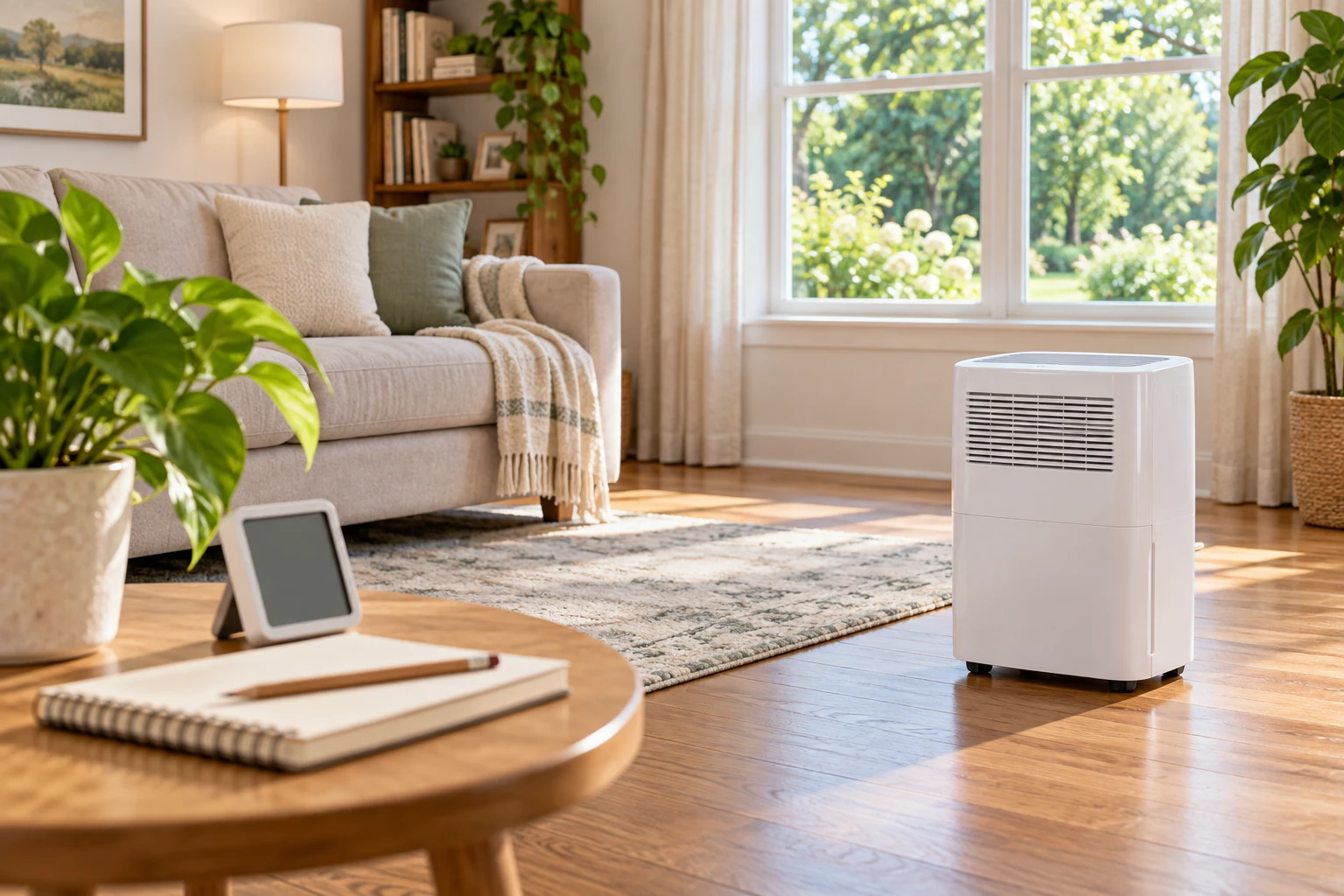
Featured image: an AI-generated illustration created for Mavelynt. It does not show a documented home assessment or endorse a particular device.