
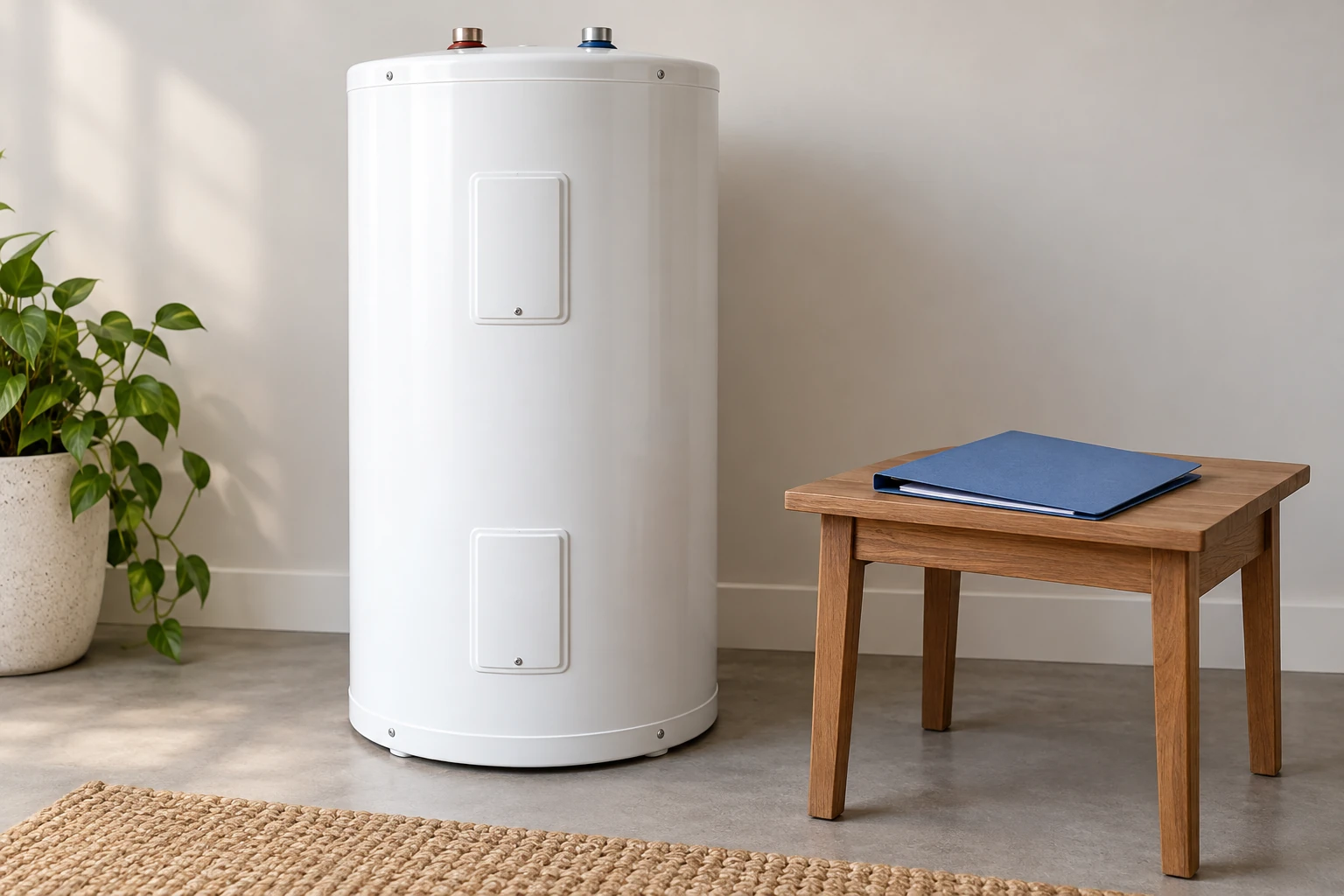
An equipment record should let a service office identify the water heater without guessing, and let you distinguish what the documents prove from what still needs checking. The useful output is one dated sheet per appliance, backed by the original documents. It is not a diagnosis or a replacement recommendation.
This guide provides that sheet and a way to resolve conflicting entries. For choosing a technology, start with water heater types. Here, the job is documenting a storage appliance already in the home.
Build one equipment sheet, with evidence beside every entry
Use an invoice, registration record, applicable owner manual, or an exterior label already readable from a dry, ordinary standing position. Do not remove a cover, move the appliance, enter a confined space, or approach hot surfaces or water near electricity. If there is a gas concern or CO alarm, leave the area and seek urgent help from safety; the record can wait.
Copy the following fields into a note or print this page. Add the source and date beside each answer. Use not verified rather than filling gaps from an online photograph. Store full serial numbers and label photographs privately.
| Field | What to enter | How to interpret the entry |
|---|---|---|
| Manufacturer and complete model | Exact spelling and all model suffixes, plus document or photograph reference | A marketing family name alone may not identify the appliance |
| Serial and product number | Every visible character from the original source | Preserve uncertain characters as uncertain; do not guess a matching model |
| Energy source and heating technology | The documented fuel and whether heating is resistance, combustion, or heat pump | A storage tank does not itself identify how water is heated |
| Nominal capacity | Value and unit exactly as labeled; retain the label's wording | Tank capacity is not a household sizing recommendation |
| Input or rating information | The labeled quantity, number, and unit together, if available | Do not compare a power input with a volume or treat it as a measured performance result |
| Manufacture information | Manufacturer-confirmed date or interpretation, with its source | This is not automatically the date the unit entered service |
| Installation information | Completion date, installer, and invoice reference if documented | Keep this separate from manufacture and property purchase dates |
| Owner documents and warranty | Exact manual/document revision, file location, registration and coverage confirmation | A similar-looking product's manual or a brochure is not proof of coverage |
| Observed condition | What was already noticed, where, and when; no testing | Record “water noticed nearby,” not an unconfirmed “tank failure” |
| Service history | Date, concern, finding, authorized work, and invoice location | Distinguish inspected, recommended, and completed work |
| Photographs | Dated, safely obtained exterior overview and readable label, if available | A picture supports identification; it does not certify installation or condition |
| Open items | Missing information, who will confirm it, and the supporting document still needed | Keep the gap visible until evidence resolves it |
- Field
- Manufacturer and complete model
- What to enter
- Exact spelling and all model suffixes, plus document or photograph reference
- How to interpret the entry
- A marketing family name alone may not identify the appliance
- Field
- Serial and product number
- What to enter
- Every visible character from the original source
- How to interpret the entry
- Preserve uncertain characters as uncertain; do not guess a matching model
- Field
- Energy source and heating technology
- What to enter
- The documented fuel and whether heating is resistance, combustion, or heat pump
- How to interpret the entry
- A storage tank does not itself identify how water is heated
- Field
- Nominal capacity
- What to enter
- Value and unit exactly as labeled; retain the label's wording
- How to interpret the entry
- Tank capacity is not a household sizing recommendation
- Field
- Input or rating information
- What to enter
- The labeled quantity, number, and unit together, if available
- How to interpret the entry
- Do not compare a power input with a volume or treat it as a measured performance result
- Field
- Manufacture information
- What to enter
- Manufacturer-confirmed date or interpretation, with its source
- How to interpret the entry
- This is not automatically the date the unit entered service
- Field
- Installation information
- What to enter
- Completion date, installer, and invoice reference if documented
- How to interpret the entry
- Keep this separate from manufacture and property purchase dates
- Field
- Owner documents and warranty
- What to enter
- Exact manual/document revision, file location, registration and coverage confirmation
- How to interpret the entry
- A similar-looking product's manual or a brochure is not proof of coverage
- Field
- Observed condition
- What to enter
- What was already noticed, where, and when; no testing
- How to interpret the entry
- Record “water noticed nearby,” not an unconfirmed “tank failure”
- Field
- Service history
- What to enter
- Date, concern, finding, authorized work, and invoice location
- How to interpret the entry
- Distinguish inspected, recommended, and completed work
- Field
- Photographs
- What to enter
- Dated, safely obtained exterior overview and readable label, if available
- How to interpret the entry
- A picture supports identification; it does not certify installation or condition
- Field
- Open items
- What to enter
- Missing information, who will confirm it, and the supporting document still needed
- How to interpret the entry
- Keep the gap visible until evidence resolves it
The DOE's equipment definitions distinguish storage, instantaneous, and heat-pump water heating. Keep energy source and technology as separate entries rather than classifying a cylinder as “electric resistance” by appearance.
Read numbers by their labels, not by their size
An equipment sheet can contain gallons, electrical ratings, heat-input ratings, and dates. These quantities answer different questions. Preserve the complete labeled entry and its units instead of extracting a bare number into a service message.
For example, a listed tank volume describes storage; it does not tell you how a replacement will handle overlapping showers. That belongs in a household sizing assessment. Likewise, copying an electrical rating is not checking whether a circuit is suitable. Leave connection and supply assessment to a qualified professional.
Rheem's serial-number guidance illustrates a manufacturer-specific date format. Use it only for the applicable product, and retain the original serial. Do not apply that decoding pattern to another brand or turn the result into an installation date.
Worked example: two dates do not necessarily conflict
Hypothetical paperwork example, not a customer case: an owner's invoice records installation in March 2022. Manufacturer confirmation identifies the same serial as manufactured in November 2021. A later service receipt says only “water heater serviced.”
The equipment sheet should retain both dates: manufacture November 2021, installation March 2022, with separate evidence references. The service receipt remains unassigned until the provider confirms which appliance it covered. None of these documents establishes remaining life, current condition, or whether maintenance was complete.
If a second document instead lists a different serial, do not combine the records into a more complete-looking history. Mark the mismatch, keep both originals, and obtain a correction from the issuing business. This prevents an old removed heater's warranty or service history from being attached to its replacement.
Send a service brief rather than the whole household file
A concise message can contain the verified model, energy/technology, reason for contact, the date of an already-noticed change, and any identification gap. Send a label image privately only when needed. Exclude unrelated household papers and personal records.
Keep the original sheet when the appliance is replaced, label it retired, and start a new sheet for the new unit. For recurring tasks and responsibility, move to the equipment-specific maintenance plan; do not turn this identification sheet into another service schedule.
Sources reviewed October 21, 2026. The worksheet and example are Mavelynt editorial tools, not manufacturer forms or professional inspections. The existing featured image is an AI-generated illustration, not a photograph of a documented installation.