
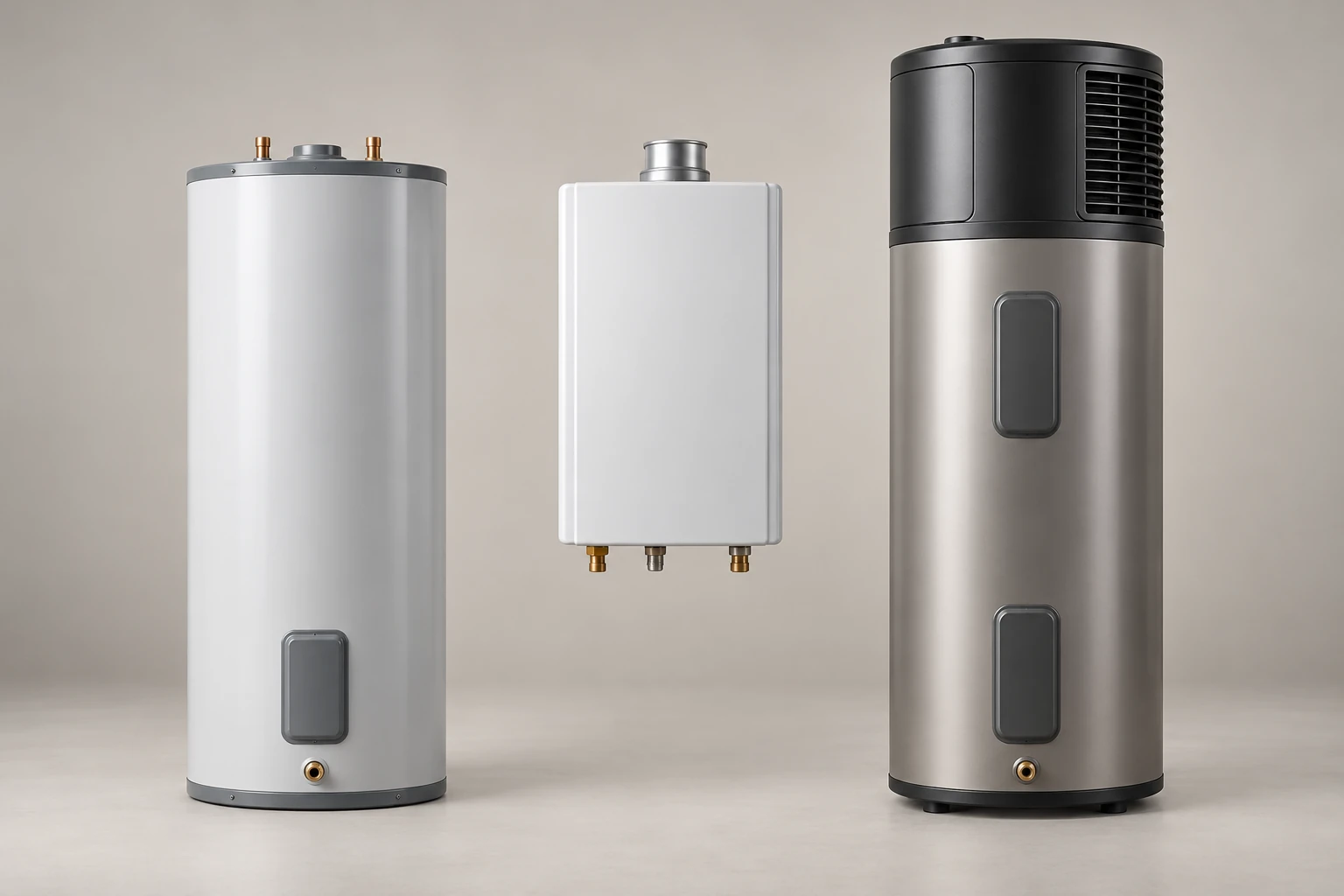
A water heater choice starts with three separate questions: does the equipment store hot water or heat it on demand, what energy source does it use, and how does it produce heat? Those questions prevent an easy mistake: treating “electric,” “tankless,” and “heat pump” as three mutually exclusive choices.
Use this guide to make a shortlist for a qualified installer to assess. It does not select a capacity, design a conversion, or promise that one technology will cost less in every home. Your existing installation and household needs belong in the comparison alongside the product name.
Separate the tank from the energy source
DOE's equipment definitions distinguish storage, instantaneous, and heat-pump water heating. For a homeowner's first conversation, “storage” describes keeping heated water in a tank; “tankless” describes heating water as it is needed. Gas and electricity describe the energy supplied, rather than whether a tank is present.
An integrated heat pump water heater generally includes a storage tank. It moves heat into the water using electrically powered heat-pump technology. Calling it a heat pump does not mean that it is a tankless appliance. ENERGY STAR's technology overview explains the heat-transfer approach.
| Description on a proposal | What it tells you | What still needs confirmation |
|---|---|---|
| Conventional storage | Water is heated and held in a tank | Fuel, exact model, delivery capability, and installation scope |
| Tankless or demand-type | Water heating responds to demand rather than relying on a conventional storage tank | Fuel, flow performance under stated conditions, and site requirements |
| Integrated heat pump water heater | A heat-pump assembly and water-storage tank form one appliance | Location suitability, operating modes, capacity, and electrical requirements |
| Electric water heater | Electricity powers the appliance | Whether heating is by resistance, heat pump, or another specified arrangement |
- Description on a proposal
- Conventional storage
- What it tells you
- Water is heated and held in a tank
- What still needs confirmation
- Fuel, exact model, delivery capability, and installation scope
- Description on a proposal
- Tankless or demand-type
- What it tells you
- Water heating responds to demand rather than relying on a conventional storage tank
- What still needs confirmation
- Fuel, flow performance under stated conditions, and site requirements
- Description on a proposal
- Integrated heat pump water heater
- What it tells you
- A heat-pump assembly and water-storage tank form one appliance
- What still needs confirmation
- Location suitability, operating modes, capacity, and electrical requirements
- Description on a proposal
- Electric water heater
- What it tells you
- Electricity powers the appliance
- What still needs confirmation
- Whether heating is by resistance, heat pump, or another specified arrangement
This table is a vocabulary aid, not an installation diagram. Solar, split heat-pump, combined space-and-water heating, and other arrangements need their own documentation. If your proposal uses one of those terms, ask the provider to explain the actual configuration rather than fitting it into an inaccurate box.
Start with your constraints
Build a shortlist before asking for a winning brand or a universal size. Write down the current equipment from paperwork, the household's normal busy-use period, and the installation location. Existing fuel or electrical service is a starting fact, not proof that it can support a different appliance. Do not inspect connections, panels, vents, or concealed spaces to fill in the sheet.
Give each candidate one of three planning labels: carry forward, assessment pending, or set aside for this project. Carry forward means worth discussing, not approved for installation. Set aside requires a stated reason, such as a documented site finding or a project constraint the household has chosen. Missing evidence belongs under assessment pending; it does not automatically rule out a technology.
| Constraint to record | What it changes in the shortlist | Evidence needed before treating it as resolved |
|---|---|---|
| Available energy and existing equipment | Separates like-for-like replacement from a change of fuel or heating method | Exact proposed model plus the provider's assessment of the required supply work |
| Location and usable space | May distinguish an appliance that fits physically from an installation that can be serviced | Model-specific location, access, and service-clearance assessment |
| Air, exhaust, and condensate | Makes combustion venting different from the air and condensate needs of an integrated HPWH | Applicable installation instructions and a documented site solution, not a generic room-size claim |
| Busy-use pattern | Keeps a technology label from standing in for delivery capacity | A sizing explanation tied to the same household routine |
| Work the household will consider | Separates the appliance shortlist from the permitted project scope | Written inclusions, exclusions, additional trades, and unresolved work |
| Ongoing ownership | Exposes an option whose routine care or access needs have not been explained | Exact-model owner requirements and who will perform tasks beyond safe owner access |
- Constraint to record
- Available energy and existing equipment
- What it changes in the shortlist
- Separates like-for-like replacement from a change of fuel or heating method
- Evidence needed before treating it as resolved
- Exact proposed model plus the provider's assessment of the required supply work
- Constraint to record
- Location and usable space
- What it changes in the shortlist
- May distinguish an appliance that fits physically from an installation that can be serviced
- Evidence needed before treating it as resolved
- Model-specific location, access, and service-clearance assessment
- Constraint to record
- Air, exhaust, and condensate
- What it changes in the shortlist
- Makes combustion venting different from the air and condensate needs of an integrated HPWH
- Evidence needed before treating it as resolved
- Applicable installation instructions and a documented site solution, not a generic room-size claim
- Constraint to record
- Busy-use pattern
- What it changes in the shortlist
- Keeps a technology label from standing in for delivery capacity
- Evidence needed before treating it as resolved
- A sizing explanation tied to the same household routine
- Constraint to record
- Work the household will consider
- What it changes in the shortlist
- Separates the appliance shortlist from the permitted project scope
- Evidence needed before treating it as resolved
- Written inclusions, exclusions, additional trades, and unresolved work
- Constraint to record
- Ongoing ownership
- What it changes in the shortlist
- Exposes an option whose routine care or access needs have not been explained
- Evidence needed before treating it as resolved
- Exact-model owner requirements and who will perform tasks beyond safe owner access
ENERGY STAR's HPWH design guidance addresses air, location, sound, and condensate, while referring back to model-specific instructions. Its general examples are not permission to declare a particular closet suitable. A professional needs to connect the proposed appliance to the actual location.
A shortlist changes when a constraint changes
Illustrative household A: an owner wants to compare a gas storage replacement with an electrically powered alternative. The records identify the current gas equipment, but electrical suitability for the new option has not been assessed. The gas option can be carried forward for a like-for-like assessment; the electric option stays assessment pending. Neither is selected from the fuel label alone. If the owner later declines the documented conversion work, that option can be set aside for this project, with that reason recorded. This is a household scope decision, not a claim that electric equipment is technically impossible.
Illustrative household B: an owner considering an integrated heat-pump water heater has a proposed model, but the location assessment has not resolved its air path and condensate arrangements. The option stays assessment pending, even if the quoted tank volume looks familiar. Once the provider documents a suitable arrangement, the shortlist can change without starting the entire search again. This example establishes no universal room volume, temperature, voltage, or drain specification.
Use the branch that answers the next unresolved question
- Comparing energy sources and conversion assumptions? Continue to gas vs electric water heaters.
- Considering on-demand delivery? Use the tankless guide for flow and waiting-time expectations.
- Comparing electrically powered heating methods? Use heat-pump vs electric-resistance water heating.
- Unsure whether an option can meet the household routine? Use water heater sizing before treating a tank label as an answer.
Understand what “hybrid” means in that proposal
ENERGY STAR uses hybrid electric terminology for heat pump water heaters. Do not read that word alone as proof that a unit combines gas and electricity. Request the exact model and the manufacturer's explanation of its modes.
Also ask which electrical supply the proposed appliance requires. The category name does not establish the requirements of every model. Leave circuit suitability, gas supply, exhaust, pressure protection, and connections to qualified professionals. This guide is not a basis for adapting an existing connection.
Keep capacity and efficiency as separate questions
“Will it supply the water we need?” and “What energy will it use?” deserve separate answers. Ask the provider to explain the capacity information for your household, then the assumptions behind any energy-cost comparison. A rating or an efficient technology label does not by itself answer both questions.
For example, if one proposal retains storage while another uses tankless equipment, ask each provider how the proposed model addresses the same morning-use pattern. Compare their explanations against the same household information. Do not turn different measurement labels into a simple bigger-number contest.
There is no equipment-size recommendation or savings percentage in this guide. Those details need current product information, the home, and the actual comparison being made.
Keep the shortlist, not a universal winner
Save one line per serious option: technology and fuel; exact model if known; carry forward, assessment pending, or set aside; evidence behind that label; and the unresolved constraint. Bring the sheet back when a site assessment arrives or the project scope changes. It lets you revise the options without repeating every technology search or assuming that the most familiar appliance is the only feasible choice.
Use the replacement quote comparison only when the options have enough definition to compare their installed scopes. Keep the maintenance requirements with the shortlist so an option's ownership responsibilities remain visible.
Sources and scope
Sources rechecked November 1, 2026. This guide uses equipment definitions and manufacturer/agency terminology, not current incentive offers, universal prices, or a home-specific design. Rinnai's official document library is an example of where to obtain exact-model documentation. The featured image is an original AI-generated conceptual illustration for Mavelynt, not a product recommendation or installation example.