
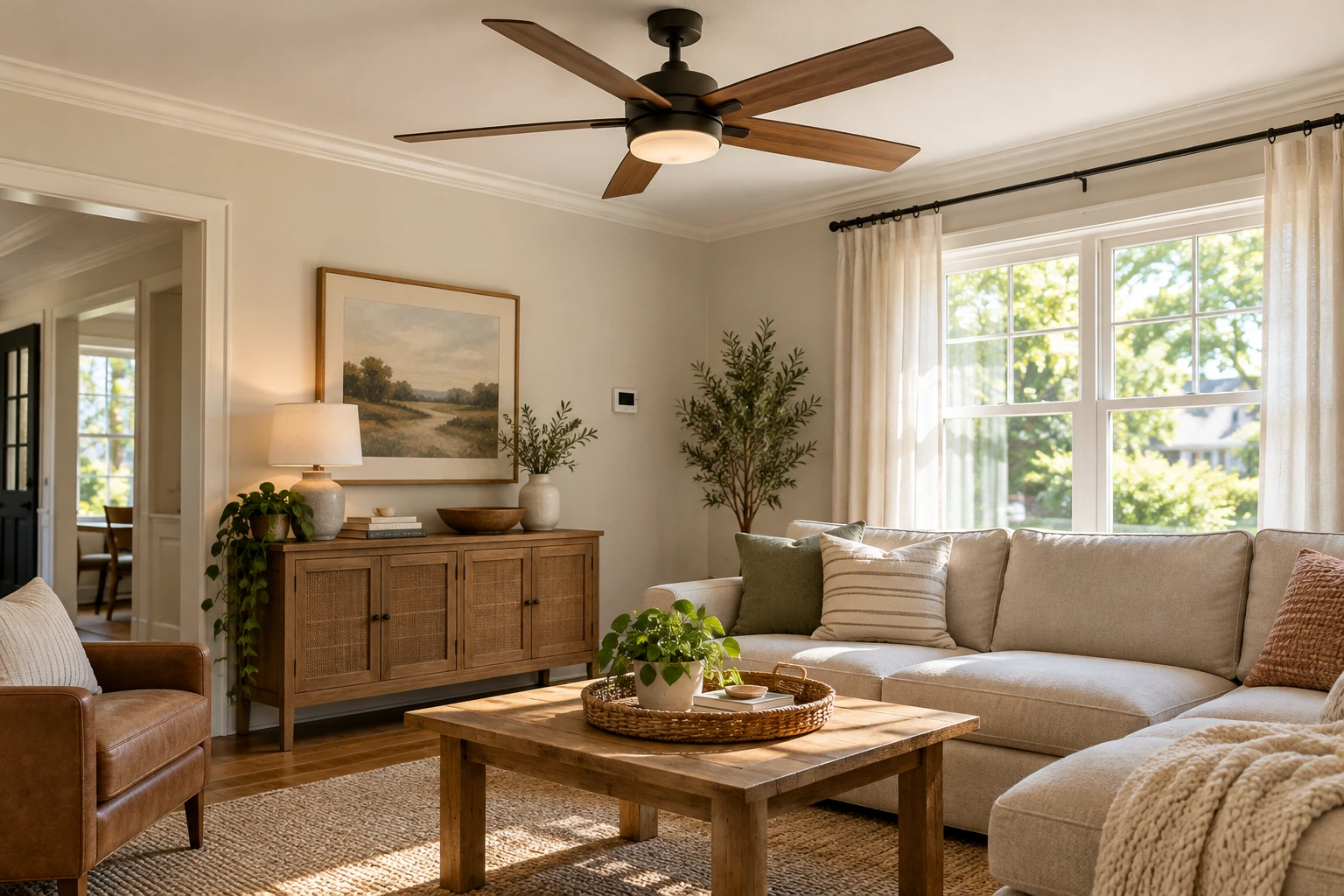
A ceiling fan can make an occupied room feel more comfortable by moving air across people. It does not work like an air conditioner, and running it in an empty room does not provide the same personal cooling benefit. Used thoughtfully, it can help you decide whether you are cooling the air more than your household needs.
Start with comfort and heat safety, not a promised thermostat number or savings percentage. Use an existing, safely installed fan according to its instructions. This guide is about ordinary operation alongside AC, not wiring, mounting, or repairing a ceiling fan.
Understand the two different jobs
South Carolina Energy Saver's fan guidance distinguishes air movement from cooling equipment. A circulating fan helps a person feel cooler; the AC changes indoor air conditions. Turning on a fan does not prove the room's air temperature or moisture has fallen.
That distinction explains why you may feel better on the sofa without seeing a lower thermostat reading. It also explains why leaving a fan on for hours before returning home is not the same as conditioning the room. Turn it off when nobody needs its breeze, following any product-specific instructions.
If the room feels persistently damp, do not treat more fan speed as a humidity solution. Our indoor humidity in summer guide addresses measuring moisture and identifying when assessment is appropriate.
Try a simple occupied-room comparison
Choose a normal period when someone is using the room. Begin with the existing AC setting and operate the fan at a comfortable speed. Assess how the breeze feels where people actually sit, rather than deciding from the center of the room while everyone uses a different area.
If the household remains comfortable, you may choose a modest adjustment to the thermostat using its ordinary controls. Change one thing at a time. If someone becomes uncomfortable, restore a suitable setting; completing an experiment is not more important than their needs.
Do not copy a universal temperature from a web article. Household health, activity, clothing, humidity, and personal preferences differ. There is no required target here and no guaranteed bill reduction. The useful outcome is a setting people can live with safely.
| Situation | Practical approach | What not to infer |
|---|---|---|
| Someone is seated in the room | Use a comfortable breeze and assess personal comfort | The fan has lowered the air temperature |
| The room is empty | Turn off the ceiling fan when its personal cooling is not needed | Continuous fan use is automatically an energy saver |
| Air feels damp | Consider a separate moisture assessment | More breeze removes moisture |
| A household member feels too warm | Use suitable AC or move to a cooler place | Everyone should tolerate the same setpoint |
| The fan shakes or makes a new sound | Stop using it and arrange qualified assessment | It is safe to tighten or repair overhead parts yourself |
- Situation
- Someone is seated in the room
- Practical approach
- Use a comfortable breeze and assess personal comfort
- What not to infer
- The fan has lowered the air temperature
- Situation
- The room is empty
- Practical approach
- Turn off the ceiling fan when its personal cooling is not needed
- What not to infer
- Continuous fan use is automatically an energy saver
- Situation
- Air feels damp
- Practical approach
- Consider a separate moisture assessment
- What not to infer
- More breeze removes moisture
- Situation
- A household member feels too warm
- Practical approach
- Use suitable AC or move to a cooler place
- What not to infer
- Everyone should tolerate the same setpoint
- Situation
- The fan shakes or makes a new sound
- Practical approach
- Stop using it and arrange qualified assessment
- What not to infer
- It is safe to tighten or repair overhead parts yourself
This is an observation exercise with existing controls. It does not determine the HVAC system's efficiency or diagnose a malfunction. Keep any notes short enough to be useful: occupancy, AC setting, fan setting, and whether people were comfortable.
Ceiling-fan controls are not the thermostat's FAN control
The ceiling fan is a separate appliance. The thermostat's FAN setting controls the HVAC system blower. Changing one does not necessarily change the other. Do not set the HVAC fan to continuous operation simply because an article recommends using a ceiling fan.
Check the instructions for each device. If your thermostat has unfamiliar circulation options, ask the installer what they do on your system. For a broader understanding of the indoor blower's role, use the equipment manual rather than guessing from the word “fan.”
For daily or away-period AC programming, use our summer thermostat schedule guide. This article stays with the breeze in an occupied room and does not prescribe a whole-house schedule.
Use direction controls without unsafe access
Follow the fan manufacturer's instructions for direction and speed. Designs and controls differ. The purpose in warm weather is to provide comfortable air movement where people are, not to follow an unlabeled switch by trial and error.
If a direction switch requires reaching the housing, stop and consult the instructions or arrange safe assistance. Do not reach toward moving blades, climb on furniture, or perform overhead adjustments beyond safe ordinary user access. A remote control is not permission to ignore a shaking fan or loose-looking mounting.
This guide does not teach balancing, bracket tightening, wiring, or replacement. Stop using a fan with damage, unusual wobble, or a new abnormal sound and have it assessed by an appropriate qualified professional.
Keep extreme-heat safety separate from comfort optimization
A fan is not a substitute for a safe indoor environment. The CDC's heat-health guidance advises using fans only when indoor temperatures are below 90°F and seeking air conditioning or a cooled location when needed. That threshold is not a guarantee of safety below it; individual vulnerability and conditions still matter.
Do not keep increasing the thermostat during dangerous heat to pursue savings. People with health concerns should follow their clinician's heat plan. Check on vulnerable household members rather than assuming that a breeze means they are safe.
If the AC is failing and the home is becoming unsafe, prioritize a cooled location and appropriate assistance. Our AC not cooling guide covers safe observations, but troubleshooting should not delay protection from heat.
What to expect from the energy discussion
Fan electricity use and any change in AC operation both matter. Without measuring the actual appliances and conditions, this article cannot calculate the net savings for your home. A lower purchase price or a breeze you can feel is not enough to produce a reliable annual dollar figure.
Use the comparison to find comfortable operation, then evaluate real utility information over an appropriate period if you want to understand consumption. Do not attribute every bill change to the fan when weather, occupancy, or rates have also changed.
Should I leave the fan running when I leave?
For its personal cooling effect, turn it off when the room is unoccupied. Follow the product instructions for any separate function your appliance may have.
Can a fan replace AC during a heat wave?
Do not rely on it as a heat-safety substitute. Follow current public-health guidance and use a safely cooled location when necessary.
Will the ceiling fan fix a room that never reaches its setting?
It may change how an occupant feels, but it does not diagnose or repair the underlying system. Report a persistent comfort problem rather than using fan speed as proof of a fix.