
A new AC noise deserves attention, but a sound is not a reliable parts diagnosis. The useful first step is to recognize an unsafe change, then record the location and timing from a safe position. Give that information to a qualified HVAC provider instead of trying to prove that a capacitor, compressor, or motor has failed.
If a normally quiet unit suddenly becomes loud, use the normal thermostat control to stop it if safe and call for service. Smoke, sparks, a burning odor, or a suspected gas leak requires moving away and seeking appropriate urgent help. Do not keep running equipment to capture a better recording.
Start with what changed
Compare the sound with the system's usual operation. Was it present from installation, or did it begin today? Does it occur at startup, during steady operation, at shutdown, or while the thermostat is no longer calling? Record what you actually know.
Trane's explanation of HVAC sounds notes that operating sounds vary and that a new loud sound should prompt shutdown and service. Its examples also show why similar descriptions can have different causes. Treat them as reasons for assessment, not a shopping list of replacement parts.
If the unit has always made a particular sound but you have never had it explained, ask the provider to relate it to the actual model. “It has always done that” is useful history, not a safety certification.
Locate the sound without approaching hazards
From an ordinary safe location, note whether the sound seems to come from the outdoor unit, indoor equipment area, a room grille, or an uncertain location. Sound can travel, so describe your impression as an impression. Do not remove panels or place an ear against a cabinet.
If the equipment is in an attic or crawl space, do not enter solely to improve the report. Say that the sound is audible from the hallway or room and leave direct inspection to the technician. Do not reach through a grille, move a fan, or touch refrigerant lines.
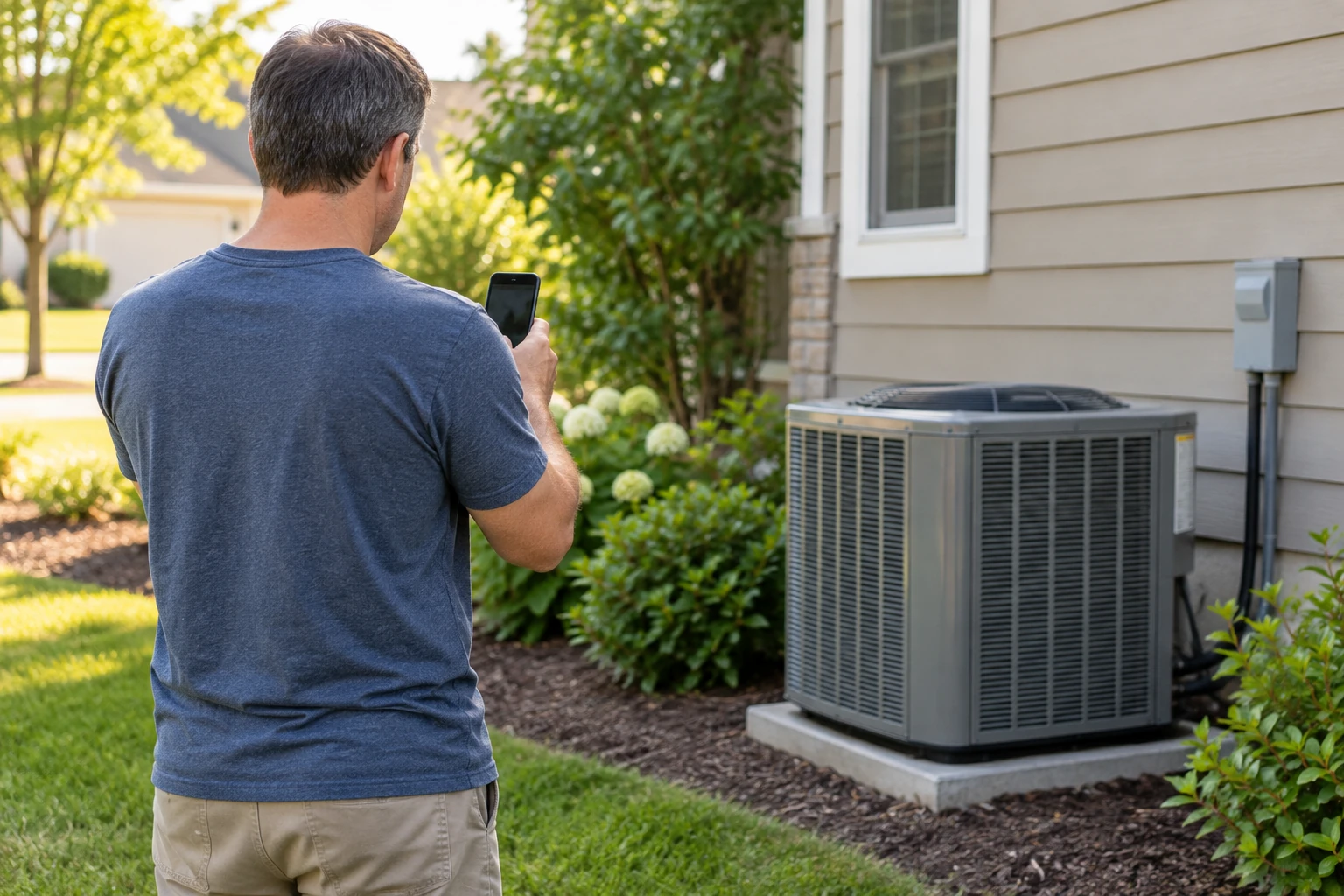
A phone recording can be helpful if you can make it without getting close or prolonging unsafe operation. Phone microphones change sound levels, so do not treat the recording as a calibrated measurement. A short description can be enough when recording is unsafe or impractical.
Prepare a useful sound record
| Record field | Example of a useful description | Avoid assuming |
|---|---|---|
| Location | Loudest from the hallway near indoor equipment | The indoor motor is definitely the cause |
| Timing | Began at startup and continued until shutdown | Startup noise is always harmless |
| Character | New rattling or repeated clicking | A named component must be replaced |
| Other symptoms | Reduced cooling or a visible error message | One symptom proves the entire diagnosis |
| History | First noticed after a visit or during ordinary use | The timing proves who caused it |
| Safety response | Stopped at the thermostat and contacted service | Repeated restarts will reveal the fault |
- Record field
- Location
- Example of a useful description
- Loudest from the hallway near indoor equipment
- Avoid assuming
- The indoor motor is definitely the cause
- Record field
- Timing
- Example of a useful description
- Began at startup and continued until shutdown
- Avoid assuming
- Startup noise is always harmless
- Record field
- Character
- Example of a useful description
- New rattling or repeated clicking
- Avoid assuming
- A named component must be replaced
- Record field
- Other symptoms
- Example of a useful description
- Reduced cooling or a visible error message
- Avoid assuming
- One symptom proves the entire diagnosis
- Record field
- History
- Example of a useful description
- First noticed after a visit or during ordinary use
- Avoid assuming
- The timing proves who caused it
- Record field
- Safety response
- Example of a useful description
- Stopped at the thermostat and contacted service
- Avoid assuming
- Repeated restarts will reveal the fault
Record the approximate time and thermostat mode. If an error message is visible, copy it exactly rather than clearing it first. Add whether the sound stopped when the ordinary call for cooling ended, but do not stage repeated starts to gather that information.
Avoid presenting a dramatic online comparison as evidence that the same part has failed. Two recordings that sound similar may come from different equipment or conditions. Your provider needs the installed system and tests, not just a matching video.
Signals to stop rather than investigate
A sudden loud change, severe vibration, scraping, or a persistent alarming sound is a reason to stop normal operation and ask for service. Do not continue running because the house still feels cool. Cooling performance alone does not establish that operation is safe.
If there is smoke, sparking, burning, or another immediate hazard, move away. If you suspect a gas leak, leave the area and contact the gas utility or emergency services from a safe location; do not operate switches to investigate. This guide does not assess combustion equipment.
If water is near electrical equipment, stay away and report it. Do not reach for a disconnect, open a panel, or reset a breaker. A thermostat OFF setting is an ordinary control action, not proof that internal components are de-energized.
Do not convert the sound into a DIY repair
Do not tighten cabinet screws, push on panels while the unit runs, lubricate motors, clear moving parts, replace capacitors, or work on electrical connections. Do not build a cover or barrier around the outdoor unit to make it quieter. Noise management must preserve equipment requirements and service access.
For a proposed outdoor screen or landscaping change, use our outdoor unit clearance guide and the model's instructions. A quieter patio is not a reason to block airflow. Have the cause of a new sound evaluated before trying to conceal it.
Do not remove a filter to see whether the sound disappears while continuing to operate. A filter or airflow concern belongs in the report. Our filter and MERV guide covers compatible owner-serviceable filters without making sound a diagnostic test.
Keep related symptoms in their own context
If the main pattern is repeated cooling starts and stops, note it and use our AC short cycling guide for a cycle-specific record. This article does not identify the cause of cycling or set a universal acceptable duration.
Likewise, do not approve compressor replacement based only on a noise description. If a provider recommends major work, ask how the finding was confirmed and what the proposal includes. Our compressor replacement cost guide helps with that later quote conversation, not sound-based diagnosis. For a separate smell-related concern, use our HVAC odor safety guidance; urgent warnings take priority over recording symptoms.
What to ask the service company
Send the location, timing, description, and any safely obtained recording. Ask whether the system should remain off until the visit and which ordinary user controls, if any, to use. Do not accept remote instructions that require opening equipment or bypassing protection.
After assessment, ask what was found and what testing supports the repair. Keep the written finding and invoice. For arranging the visit, see our air conditioner repair contractor guide.
Can I identify a bad capacitor by a humming sound?
No. A sound is not enough to confirm that component or justify handling it. Electrical diagnosis and capacitor work belong to qualified professionals.
Should I restart the AC so the technician can hear it?
Do not repeatedly restart an abnormal system. Describe the event and ask the provider how to proceed safely.
Does a quieter sound mean the problem fixed itself?
Not necessarily. Report an unexplained change and any associated symptoms. A single quiet period does not confirm the equipment's condition.