
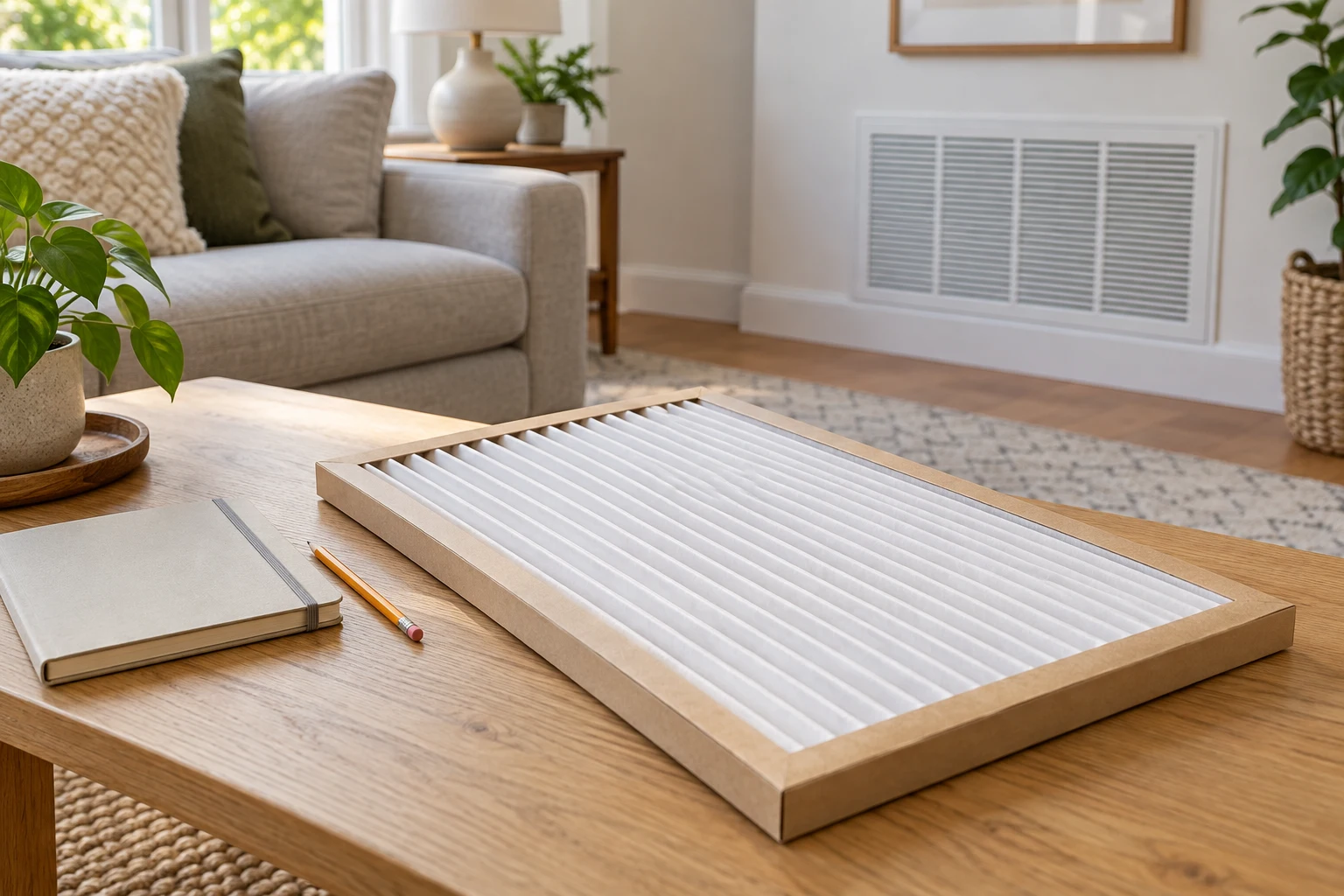
Choosing an HVAC air filter is not simply a matter of buying the highest number on the shelf. The useful choice is a filter that captures the particles you are concerned about, fits the intended location, and works with your system's airflow requirements. A rating on a package does not confirm all three.
This guide helps U.S. homeowners compare replacement filters for ducted central heating and air conditioning. It focuses on the purchasing decision, not diagnosing a cooling failure or modifying equipment. If you have a window unit or ductless system, use its own filter instructions rather than assuming a central-system filter is interchangeable.
What the MERV Rating Tells You
MERV stands for Minimum Efficiency Reporting Value. EPA explains that the rating compares particle capture using a test method developed by ASHRAE. A higher rating indicates better capture for particular particle sizes; it is not a rating of how well your entire home will be cooled or how long the filter will last.
For an upgrade, EPA recommends MERV 13 or the highest rating the system fan and filter slot can accommodate. The compatibility condition matters. That recommendation is not permission to install any MERV 13 product in any system. EPA advises consulting an HVAC professional when needed to determine what will work.
Separate two questions when shopping: “What particle-capture rating does this filter have?” and “Is this exact filter suitable for my equipment?” Keep both answers with the product details. Neither a familiar brand nor a larger rating supplies the missing compatibility answer.
Compare MERV 8, 11, and 13 Without Guessing About Airflow
EPA's MERV reference table helps explain why common ratings differ. For example, MERV 13 has a minimum average capture efficiency of 50% for the 0.3–1.0 micron particle-size band in that table. This is a filter-test threshold, not a promise that half of every pollutant in your home will disappear.
The practical comparison is not “low number bad, high number good.” Carrier's MERV guidance explains that the filter's construction, size, installation, and HVAC equipment affect actual performance and pressure drop. Higher-efficiency filtration can be too restrictive for some systems. MERV alone does not establish that a particular replacement will preserve adequate airflow.
| Option under consideration | Question to resolve before buying |
|---|---|
| Another MERV 8 filter | Is this the documented replacement, including its size and product specifications, rather than just the same rating? |
| A move to MERV 11 | Has compatibility been confirmed for this product and equipment, rather than inferred from a moderate-looking number? |
| A move to MERV 13 | Does the system support this exact filter while maintaining the airflow it requires? |
| A filter with a different rating label | Is a MERV specification available so you are comparing the same measure? |
- Option under consideration
- Another MERV 8 filter
- Question to resolve before buying
- Is this the documented replacement, including its size and product specifications, rather than just the same rating?
- Option under consideration
- A move to MERV 11
- Question to resolve before buying
- Has compatibility been confirmed for this product and equipment, rather than inferred from a moderate-looking number?
- Option under consideration
- A move to MERV 13
- Question to resolve before buying
- Does the system support this exact filter while maintaining the airflow it requires?
- Option under consideration
- A filter with a different rating label
- Question to resolve before buying
- Is a MERV specification available so you are comparing the same measure?
These are purchase questions, not a table assigning a universal “best” filter. Do not infer that every MERV 8 product is safe for every system or that every MERV 13 product causes a problem. If the manual does not settle the choice, ask a qualified technician to identify an appropriate product and explain the basis for the recommendation.
Confirm Fit Before Ordering a Multipack
EPA's air-cleaner guide says a filter should fit snugly without bending or crushing it into place, so air does not pass around its edges. A filter that fits poorly is not made suitable by an impressive efficiency rating.
Start with records you already have: the equipment manual, a confirmed replacement part number, or a previous professional recommendation. Treat the installed filter as a clue, not proof that an earlier owner bought the correct one. Note its labeled dimensions and product details only if you can obtain them safely; there is no need to open a service compartment to complete a shopping list.
Before purchasing several filters, resolve any discrepancy between the product listing, your records, and the intended filter location. Ask the supplier or technician to confirm the exact replacement. Do not force an oversized filter, improvise a frame, or modify the rack to make an online purchase work. A different filter cabinet or other equipment alteration is professional work, outside this guide.
Make a Filter Record You Can Reuse
A short record prevents the next purchase from starting with a guess. Use the table as a checklist, not as a requirement to collect inaccessible information. Write “not yet confirmed” where necessary, then resolve that item before changing products.
| Record | What to keep |
|---|---|
| System served | Which heating or cooling system the filter belongs to, especially if the home has more than one |
| Approved replacement | Exact product or part number and the source of that recommendation |
| Size and fit | Dimensions specified for the replacement and any unresolved fit question |
| Filtration rating | The documented MERV value, rather than an assumed conversion from another label |
| Compatibility evidence | Manual reference or technician's explanation for the selected product |
| Care instructions | Whether the product is disposable or reusable and its own maintenance instructions |
| Follow-up | Installation date, inspection reminder, and questions to raise at service |
- Record
- System served
- What to keep
- Which heating or cooling system the filter belongs to, especially if the home has more than one
- Record
- Approved replacement
- What to keep
- Exact product or part number and the source of that recommendation
- Record
- Size and fit
- What to keep
- Dimensions specified for the replacement and any unresolved fit question
- Record
- Filtration rating
- What to keep
- The documented MERV value, rather than an assumed conversion from another label
- Record
- Compatibility evidence
- What to keep
- Manual reference or technician's explanation for the selected product
- Record
- Care instructions
- What to keep
- Whether the product is disposable or reusable and its own maintenance instructions
- Record
- Follow-up
- What to keep
- Installation date, inspection reminder, and questions to raise at service
Save the product information with your equipment records. If a recommendation changes, record why rather than silently replacing the old note. This is particularly useful when one person orders filters and another arranges maintenance.
A practical question to send a contractor is: “I have this equipment and this documented replacement. Is this proposed filter compatible, and what inspection or replacement instructions should I follow?” Attach only information already available safely. That is more useful than asking whether one MERV number is always better than another.
Set a Check Schedule, Not a Universal Expiration Date
ENERGY STAR recommends inspecting, cleaning, or changing filters monthly and notes that dirty filters can raise energy costs and damage equipment. A monthly check is a useful reminder; it does not make every filter a monthly disposable item. Follow the filter and equipment manufacturer's instructions for the actual maintenance required.
Carrier's filter overview distinguishes disposable filters from washable products. Do not wash a disposable filter or assume a reusable product has the same care instructions as another model. If you cannot identify the product, ask before attempting to clean it.
You do not need to buy a maintenance membership solely to keep a filter record. If a provider offers filter service as part of a plan, ask which filters are supplied and what happens between visits. Our AC maintenance and service-plan guide covers those contract questions separately.
Keep Filtration Expectations Realistic
EPA explains that filtration supplements source control and ventilation; it does not remove every indoor pollutant. Central HVAC filters generally address particles. A particle-filter rating does not establish protection against gases or guarantee that an odor will be removed. Filtration also does not correct the moisture source behind mold. See EPA's guide to air cleaners for these limits.
Do not buy a filter on the assumption that a higher number will solve an unexplained indoor-air problem. Describe the concern accurately and seek advice appropriate to that problem. This article makes no promise about allergy relief, illness prevention, energy savings, or extended equipment life.
Know When to Stop and Ask for Help
Use only the routine filter access and procedure the manufacturer identifies as appropriate for homeowners. If reaching it requires unsafe climbing, entering a hazardous space, or exposing wiring or moving components, arrange professional help. Do not stack filters, bypass the intended filter, alter fan settings inside the equipment, or open electrical compartments to experiment with airflow.
If comfort changes after a filter replacement, record what changed and the product used. Do not diagnose the cause from timing alone or keep experimenting with equipment settings. For an existing cooling problem, our AC not cooling guide explains safe observations and when to stop. For finding professional help, use our air conditioner service-visit guide.
The goal is a documented, compatible replacement you can maintain safely. Resolve the product, fit, and care questions before treating the shopping decision as complete.
Sources and Review Scope
Sources checked October 11, 2026. This is a filter-selection guide, not a system inspection, product test, medical recommendation, or claim of professional HVAC review. No price, search-volume, or energy-savings estimate is used.
- EPA: What Is a MERV Rating? — rating meaning, limited test example, and compatibility-qualified upgrade guidance.
- EPA: Guide to Air Cleaners in the Home — fit and limits of filtration.
- Carrier: What Is a MERV Rating? — product-specific airflow considerations; manufacturer guidance with commercial context.
- Carrier: All About AC Filters — disposable and reusable filter distinction; not used for universal prices or replacement intervals.
- ENERGY STAR: Maintenance Checklist — routine filter checks.
Featured image: an AI-generated illustration created for Mavelynt. It does not depict a tested filter or prove any product's MERV rating or compatibility.