
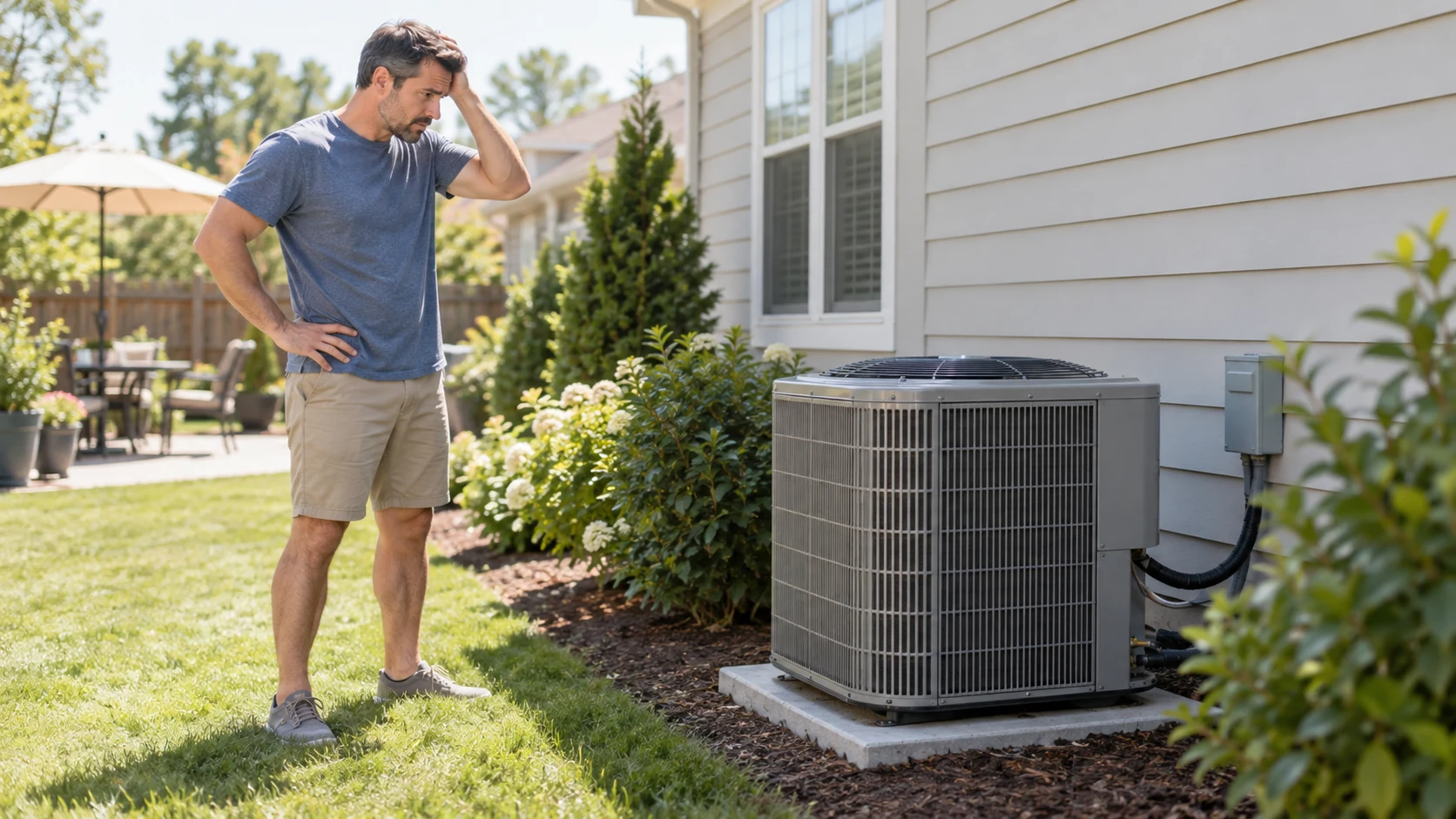
Start with the thermostat display, accessible vents, and a visual check of the outdoor area. Check a filter only if your system’s manual provides safe homeowner access. Use the safety steps below before beginning; several problems can cause the same symptom, so these checks cannot identify a failed part.
This guide covers residential central air conditioning, primarily split systems with indoor and outdoor components. Window units, portable ACs, mini-splits, and heat pumps need their own instructions. U.S. Department of Energy.
Start Here: What to Check—and When to Stop
Signs to Stop Troubleshooting Immediately
- Fire or smoke indicating a fire: leave and stay outside. Do not delay to collect equipment information or turn off the AC. Contact emergency services. If you cannot escape, the U.S. Fire Administration advises getting behind a closed door and calling 911. USFA fire guidance, USFA escape guidance.
- A burning smell or sparks: stop troubleshooting. Turn the system off only from a safely accessible control, without approaching the suspected hazard. Get professional help; if there is a fire, use the emergency response above. Trane.
- Water touching or near electrical equipment: keep away and seek qualified electrical help. Do not cross standing water to reach a switch or operate electrical controls while wet. CDC’s disaster guidance supports this precaution against electrical exposure; it does not diagnose the cause of water around your AC. CDC.
Visible Ice
Stop the checks and call an HVAC professional. Change COOL to OFF only at a safely accessible control, without approaching an electrical or other hazard. Do not scrape, strike, or try to remove ice; do not apply heat, touch tubing, or open the unit. Do not plan a restart around an assumed thawing time. Trane’s frozen-coil guidance.
Safe Checks Before You Call for Service
Review the Thermostat Display and Settings
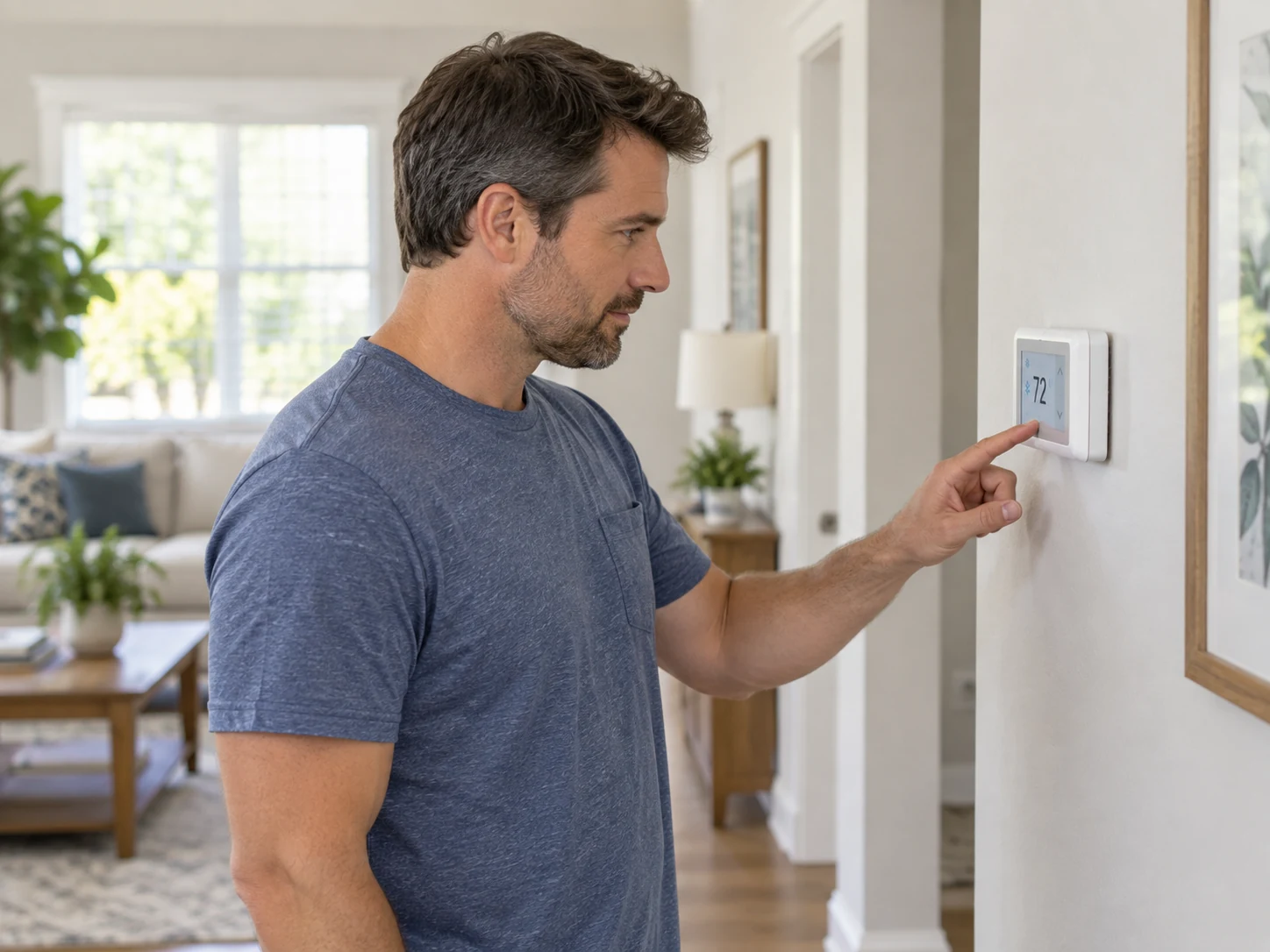
Safe homeowner check: read the operating mode, room temperature, and set temperature. Following your thermostat’s instructions, check whether cooling is selected and whether the set temperature is below the displayed room temperature.
Stay with the user controls; do not remove the thermostat, inspect wiring, or attempt a reset. If you do not recognize a setting, consult the manual or ask the service company. Carrier.
Look for Blocked Vents and an Accessible Filter
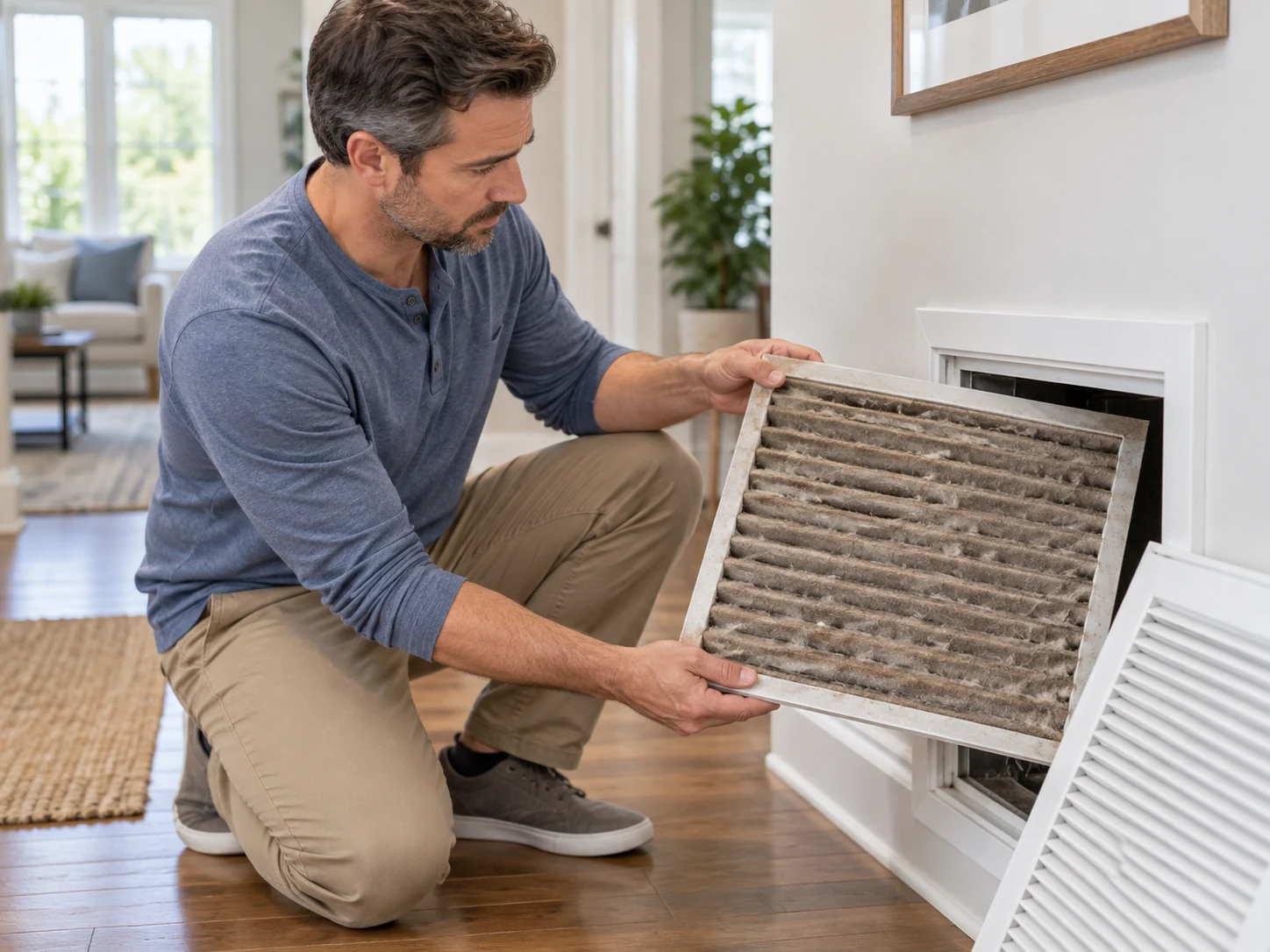
Safe homeowner check: look at accessible vents and return grilles for visible obstructions. Do not insert objects or adjust internal components. Trane.
A restricted filter can reduce airflow, but its appearance alone does not diagnose the cooling problem. Before inspecting or replacing it, confirm that the manual identifies both the access point and procedure as homeowner maintenance. Skip the task if it requires a service panel, a ladder, or exposure to components. DOE, ENERGY STAR.
Observe the Outdoor Unit from a Safe Distance
Safe homeowner check: from an accessible location, note visible vegetation or debris around the outdoor unit. Obstructions can interfere with its ability to release heat. Do not touch the fan, fins, wiring, or interior. Carrier.
Cleaning recommendations vary by equipment and guidance. Use the applicable manual or professional advice rather than a generic coil-washing procedure. Carrier, Trane.
For a sound-specific observation record, see our guide to recording an unusual AC noise safely.
Match Your Symptom to the Next Safe Step
- Warning signs or visible ice? Use the safety steps or ice instructions first. Do not continue into routine checks.
- Little or no air? Go to vents and filter access. If access is uncertain or airflow remains poor, stop and arrange service.
- Air moves but is not cool? Review thermostat settings, then make only the exterior visual check. If cooling remains poor, use the service sheet.
- Only some rooms are affected? Check their accessible grilles for visible obstructions. If the problem persists, include those rooms in the service sheet; do not alter ducts or internal dampers.
- Unusual repeated stops, a stopped outdoor unit, or a new sound or smell? End the checks if further investigation would require opening or testing equipment. Use the safety steps for danger signs; otherwise describe the behavior when arranging service.
| What you notice | What it might indicate | Safe check | When to stop |
|---|---|---|---|
| Little or no air | A setting, airflow restriction, or blower problem may be involved. | Review display and grilles; filter only with documented user access. | Uncertain access or persistent poor airflow. |
| Air moves but is not cool | Settings, coil conditions, or refrigerant problems may be involved. | Review thermostat; look at the outdoor area. | Persistent problem; no component or refrigerant tests. |
| Weak cooling throughout the house | Airflow, coils, or insufficient capacity may contribute. | Check visible obstructions. | Leave sizing and temperature tests to a professional. |
| Some rooms are warmer | Restrictions or duct problems may contribute. | Check accessible grilles. | No attic access or duct modifications. |
| Outdoor unit appears stopped | Controls or components may need assessment. | Exterior observation only. | No cabinet access or moving the fan. |
| Repeated stops and starts | Several equipment conditions may be involved. | Read any visible code. | No resets or bypassing protections. |
| Visible ice | Airflow or refrigerant conditions may contribute. | No further routine checks. | Follow the ice instructions. |
| New noise or odor | The cause is uncertain without assessment. | Use only what you already noticed. | Do not approach to locate it; apply safety steps. |
- What you notice
- Little or no air
- What it might indicate
- A setting, airflow restriction, or blower problem may be involved.
- Safe check
- Review display and grilles; filter only with documented user access.
- When to stop
- Uncertain access or persistent poor airflow.
- What you notice
- Air moves but is not cool
- What it might indicate
- Settings, coil conditions, or refrigerant problems may be involved.
- Safe check
- Review thermostat; look at the outdoor area.
- When to stop
- Persistent problem; no component or refrigerant tests.
- What you notice
- Weak cooling throughout the house
- What it might indicate
- Airflow, coils, or insufficient capacity may contribute.
- Safe check
- Check visible obstructions.
- When to stop
- Leave sizing and temperature tests to a professional.
- What you notice
- Some rooms are warmer
- What it might indicate
- Restrictions or duct problems may contribute.
- Safe check
- Check accessible grilles.
- When to stop
- No attic access or duct modifications.
- What you notice
- Outdoor unit appears stopped
- What it might indicate
- Controls or components may need assessment.
- Safe check
- Exterior observation only.
- When to stop
- No cabinet access or moving the fan.
- What you notice
- Repeated stops and starts
- What it might indicate
- Several equipment conditions may be involved.
- Safe check
- Read any visible code.
- When to stop
- No resets or bypassing protections.
- What you notice
- Visible ice
- What it might indicate
- Airflow or refrigerant conditions may contribute.
- Safe check
- No further routine checks.
- When to stop
- Follow the ice instructions.
- What you notice
- New noise or odor
- What it might indicate
- The cause is uncertain without assessment.
- Safe check
- Use only what you already noticed.
- When to stop
- Do not approach to locate it; apply safety steps.
A running fan does not confirm that the compressor is working, and a stopped outdoor unit does not identify a failed part. If you already know a breaker has tripped, tell the technician; do not approach or open the panel to investigate or reset it. Trane.
Ordinary operating cycles are not automatically a fault. Unusual repeated interruptions need assessment in context, not a universal minute-based test. Trane’s short-cycling guidance.
What Could Be Causing the Problem?
Settings and Airflow Restrictions
An incorrect cooling setting may explain why the system is not responding as expected. Carrier.
Restricted airflow can involve a filter or blocked grille; blower operation may also need professional assessment. These are possible explanations, not evidence that a motor has failed. DOE, Trane, ENERGY STAR.
Ice, Coil Conditions, and Heat Transfer
Dirty coils can reduce cooling performance. ENERGY STAR.
Ice may be associated with restricted airflow or refrigerant conditions, but it does not prove a leak. Too little refrigerant is another possible explanation for poor cooling; warm air alone does not establish that diagnosis. Trane.
Faults That Need Professional Testing
Electrical connections, controls, capacitors, and the compressor require professional evaluation. Trane.
Leaking or poorly connected ducts can contribute to rooms that are difficult to cool. Uneven temperatures alone do not confirm a duct leak. ENERGY STAR.
Before authorizing duct work, understand the difference between duct sealing and duct cleaning; they address different findings.
A blocked condensate drain can cause water damage. That does not establish why a system stopped or mean that every system has a drain safety switch. ENERGY STAR.
Capacity that is insufficient for the home’s cooling needs may contribute to poor cooling. Discomfort alone does not prove incorrect sizing; leave that assessment to a professional. Carrier.
What Not to Try Yourself
Do not attempt electrical-compartment access, capacitor handling, compressor repair, refrigerant testing or charging, or bypassing controls. Do not use electrical resets, DIY drain-clearing, or improvised thawing as troubleshooting steps.
Switching the thermostat off is not electrical isolation. OSHA distinguishes controls from isolation and addresses stored energy in its workplace standard; this is a safety distinction, not a universal homeowner legal requirement. OSHA.
Leave refrigerant work to an appropriately qualified professional. EPA Section 608 requires certification for covered service activities and refrigerants, with provisions for supervised apprentices. It does not cover every homeowner maintenance task or replace applicable local licensing. EPA.
When to Call an HVAC Technician
Arrange service if your air conditioner is not cooling after the accessible checks, the problem returns, or further investigation requires component testing or service-compartment access. Use emergency or qualified electrical help for the hazards described at the start.
For a non-emergency visit, see our guide to choosing an AC repair contractor and preparing for the appointment.
What to Record Before the Service Visit
Complete this sheet with information you already have. Keep it with your service history so you can describe changes if the problem returns.
| Service call sheet | Your notes |
|---|---|
| When did it start? Continuous or intermittent? | |
| Is air moving? Whole house or particular rooms? | |
| Thermostat mode, displayed temperatures, or visible code | |
| Ice or water already visible without opening equipment | |
| Outdoor-unit behavior, sounds, or odors already noticed | |
| Relevant recent maintenance or service | |
| Safe checks already completed | |
| Model number, only if already known or safely available |
- Service call sheet
- When did it start? Continuous or intermittent?
- Your notes
- Service call sheet
- Is air moving? Whole house or particular rooms?
- Your notes
- Service call sheet
- Thermostat mode, displayed temperatures, or visible code
- Your notes
- Service call sheet
- Ice or water already visible without opening equipment
- Your notes
- Service call sheet
- Outdoor-unit behavior, sounds, or odors already noticed
- Your notes
- Service call sheet
- Relevant recent maintenance or service
- Your notes
- Service call sheet
- Safe checks already completed
- Your notes
- Service call sheet
- Model number, only if already known or safely available
- Your notes
“I don’t know” is better than opening equipment or approaching a hazard to fill in a detail.
What Can Affect the Repair Estimate?
The work required, parts, labor, location, urgency, and warranty terms can affect the estimate. Ask what the proposed work includes and check the actual warranty contract; do not assume a particular repair or labor charge is covered. Trane.
Our guide to comparing written HVAC repair quotes explains how to check scope, fees, and exclusions.
Maintenance That May Help Prevent Recurring Problems
Checking a filter and replacing it are different tasks. Replacement needs vary with the filter, system use, household conditions, and environment. Follow the applicable manual and filter instructions, with the same safe-access limits described above. Carrier.
ENERGY STAR recommends an annual professional checkup before the cooling season. This is guidance, not a universal requirement or a guarantee against faults. Follow model-specific instructions for the area around the outdoor unit. ENERGY STAR.