
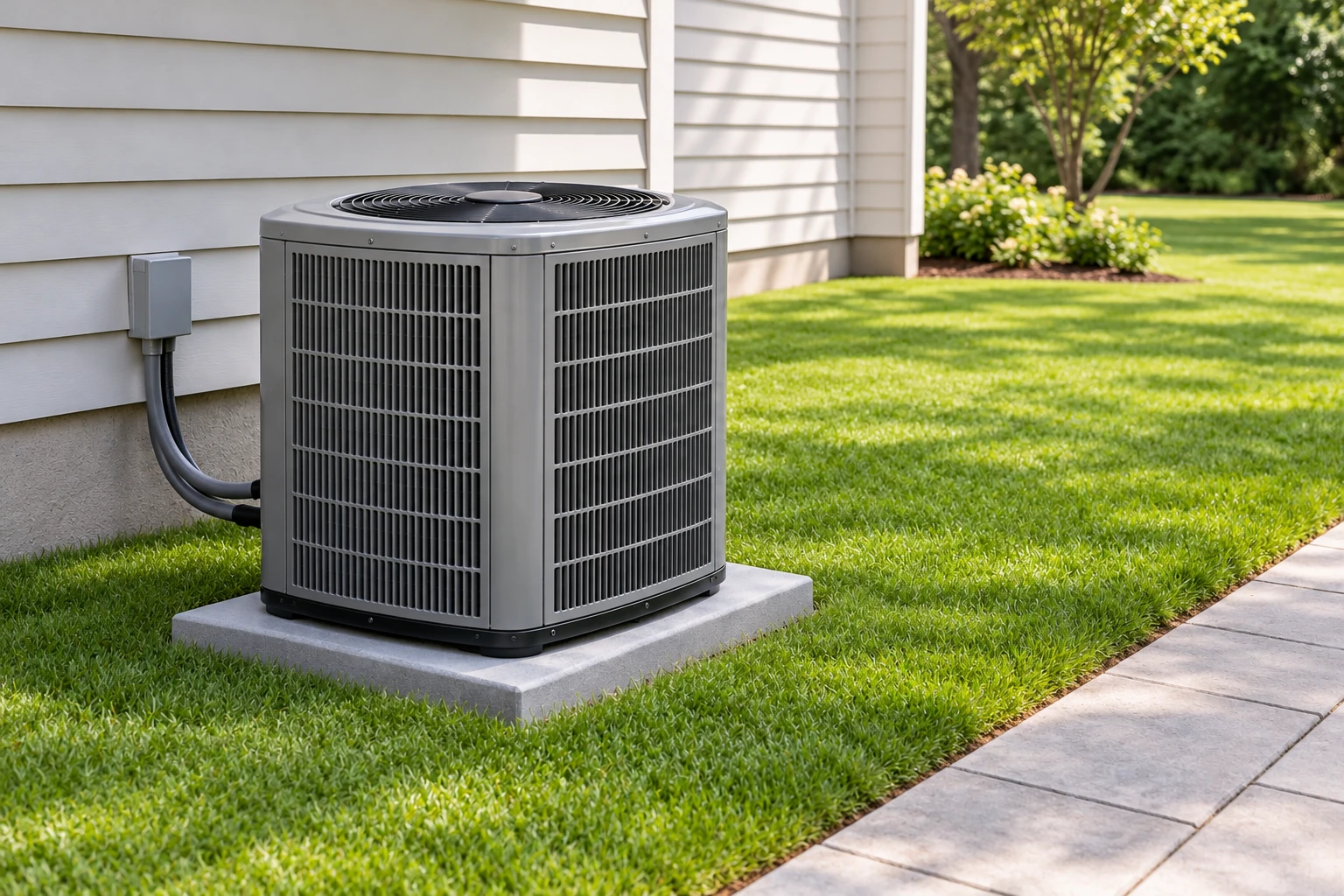
The space around an outdoor AC unit is working space, not spare storage. Before adding plants, a fence, or a decorative screen, check the unit's model-specific clearance requirements and preserve access for service. A tidy enclosure can still obstruct the equipment.
This guide is for homeowners planning the area around an existing outdoor central AC unit. It covers visible obstacles and landscaping decisions, not installation, relocation, coil washing, or electrical work. Do not move the unit, remove its panels, or reach through a grille.
Why open space matters
The outdoor unit needs airflow to release heat during cooling. Carrier's AC maintenance guidance explains that its fan draws air through the condenser coil and that debris can restrict that flow. Clearing the surrounding area and cleaning the coil itself are different jobs.
An open path also lets a technician approach the equipment without moving heavy landscaping or dismantling a new fence. A plan should account for both normal operation and service access. Neither can be judged reliably from a photograph of someone else's installation.
Use the manual before choosing a distance
Trane's landscaping guidance recommends keeping plants about 2–3 feet from the unit and describes overhead clearance as another consideration. Treat those figures as that manufacturer's general landscaping guidance, not a universal installation rule for every model, wall, screen, or enclosure.
Find the exact model in your equipment paperwork or on an externally readable label, without removing anything. Ask the installer or manufacturer for the applicable clearance instructions. If the documentation is missing or the existing location is tight, get the layout assessed before buying plants or constructing a screen.
Do not assume that a general plant-spacing recommendation also approves a solid fence at the same distance. Ask about each obstruction separately, including anything overhead and the route needed to reach service panels. Keep the answer with the system's maintenance records so future yard work does not undo it.
Make a simple clearance map
From a safe position on the ground, photograph the closed unit and its surroundings. Sketch the house wall, nearby plants, proposed screen, and service approach. Mark what is existing and what you want to add. You do not need to touch the cabinet or measure inside it.
Use the sketch to ask a concrete question: “Will this proposed screen leave the required airflow and service space for this model?” That is more useful than asking whether a particular fence style is generally AC-friendly.
| Area to review | What to note | When to ask for help |
|---|---|---|
| Sides of the cabinet | Plants, stored objects, fencing, and mature plant spread | Required distances are unknown or an obstruction is fixed |
| Space above the unit | Branches, a deck, awning, or proposed cover | Anything may interfere with the unit's required open space |
| Service approach | A clear route and access to panels | A fence or heavy planting would need removal for service |
| Ground beside the pad | Leaves, grass clippings, and loose stored items | Clearing debris would require reaching into equipment |
| Visible condition | Damage, leaning equipment, or disturbed connections | The unit or its connections appear damaged or unstable |
- Area to review
- Sides of the cabinet
- What to note
- Plants, stored objects, fencing, and mature plant spread
- When to ask for help
- Required distances are unknown or an obstruction is fixed
- Area to review
- Space above the unit
- What to note
- Branches, a deck, awning, or proposed cover
- When to ask for help
- Anything may interfere with the unit's required open space
- Area to review
- Service approach
- What to note
- A clear route and access to panels
- When to ask for help
- A fence or heavy planting would need removal for service
- Area to review
- Ground beside the pad
- What to note
- Leaves, grass clippings, and loose stored items
- When to ask for help
- Clearing debris would require reaching into equipment
- Area to review
- Visible condition
- What to note
- Damage, leaning equipment, or disturbed connections
- When to ask for help
- The unit or its connections appear damaged or unstable
This is a planning checklist, not a code-compliance inspection. Do not attempt to level a pad, reroute a pipe, or repair an electrical connection based on the sketch.
Choose plants for their mature size
Allow for the space the plant will occupy after growth, not only its nursery-pot size. Ask the landscaper how the proposed planting will be kept outside the equipment's required clear area and who will maintain that space. Avoid placing a plant where routine growth will make access dependent on aggressive trimming.
Separate ordinary yard care from work close to equipment. Picking up loose items well away from the cabinet is different from cutting a vine wrapped around a pipe or reaching under the unit. Leave entangled growth, work near connections, and overhead cutting to appropriately qualified help.
Trane also advises directing mower discharge away from the outdoor unit. Share that constraint with anyone maintaining the lawn. Do not use the condenser cabinet as a shelf for bags, garden tools, or equipment while working nearby.
Screens and covers need a separate decision
A screen should not be treated as safe merely because air can pass through some of its openings. Provide its dimensions and location to the HVAC professional before installation. Ask how service access will be maintained without moving or disconnecting the unit.
Do not build a roof over the condenser or add a cover to claim energy savings. This guide provides no percentage savings from shade or landscaping, and a decorative project should not compromise the manufacturer's required space.
Trane's maintenance advice warns against operating an AC with a protective cover in place. Seasonal covering is equipment- and climate-dependent. If you are unsure whether the outdoor equipment also provides winter heating, identify the system before considering a cover; our heat pump versus air conditioner explanation clarifies that distinction.
Keep yard care separate from coil service
A clean-looking yard does not establish that the coil is clean, and visible dirt does not justify spraying chemicals or water into the unit. Trane's coil-maintenance guidance describes professional cleaning and warns that high-pressure washing can damage coils. Do not use a pressure washer, remove a grille, straighten fins, or insert tools as part of this yard check. Our guide to professional condenser coil cleaning scope covers that separate service discussion.
ENERGY STAR includes coil, electrical, refrigerant, and blower checks in professional maintenance. For comparing the scope of a visit or service agreement, see our AC tune-up and maintenance-plan guide. This article does not replace that assessment or set a universal service interval.
If the system already has poor cooling, unusual noise, visible damage, or repeated shutdowns, report those symptoms rather than assuming nearby plants explain everything. Our guide to choosing a repair contractor can help you prepare for a professional visit.
When to look around the unit again
Revisit the visible space after landscaping changes, mowing, heavy leaf fall, or a storm, provided the area is safe to approach. Stay away from fallen electrical lines, damaged equipment, flooding, or unstable branches. Those conditions require appropriate professional or emergency assistance, not routine yard care.
There is no single calendar interval that fits every yard. A location beside fast-growing plants may need attention sooner than an open paved area. The practical question is whether today's surroundings still match the clearance and access plan approved for your equipment.
Questions to settle before a landscaping project
- Which model-specific instructions apply to each side and the space above this unit?
- Will the proposed plant's mature size remain outside that space?
- Can service panels be reached without removing the fence or landscaping?
- Does the plan require digging near utilities or equipment connections, and who will arrange the appropriate checks?
- Who will maintain access as plants grow?
- Is any existing obstruction a problem that should be assessed before new work begins?
Keep written answers with the project plan. If the installer and landscaper are working from different assumptions, resolve those before construction rather than after a screen or planting is in place.
Questions homeowners often ask
Is two feet always enough?
No. General landscaping guidance is not a substitute for the exact model's requirements. Fixed barriers, overhead structures, and service access need their own evaluation.
Can I hide the AC behind a fence?
Possibly, but have the proposed location and design checked before building it. Appearance alone cannot establish adequate airflow or access.
Should I wash the coil while cleaning the yard?
No. Keep this task to safe observations and ordinary surroundings. Ask the service provider about coil condition and the manufacturer-approved cleaning method.
Will clearing the area guarantee lower bills?
No. Maintaining required space supports proper operation, but it does not establish a particular saving or correct every cause of high energy use. Avoid promises of a payback based only on landscaping.