
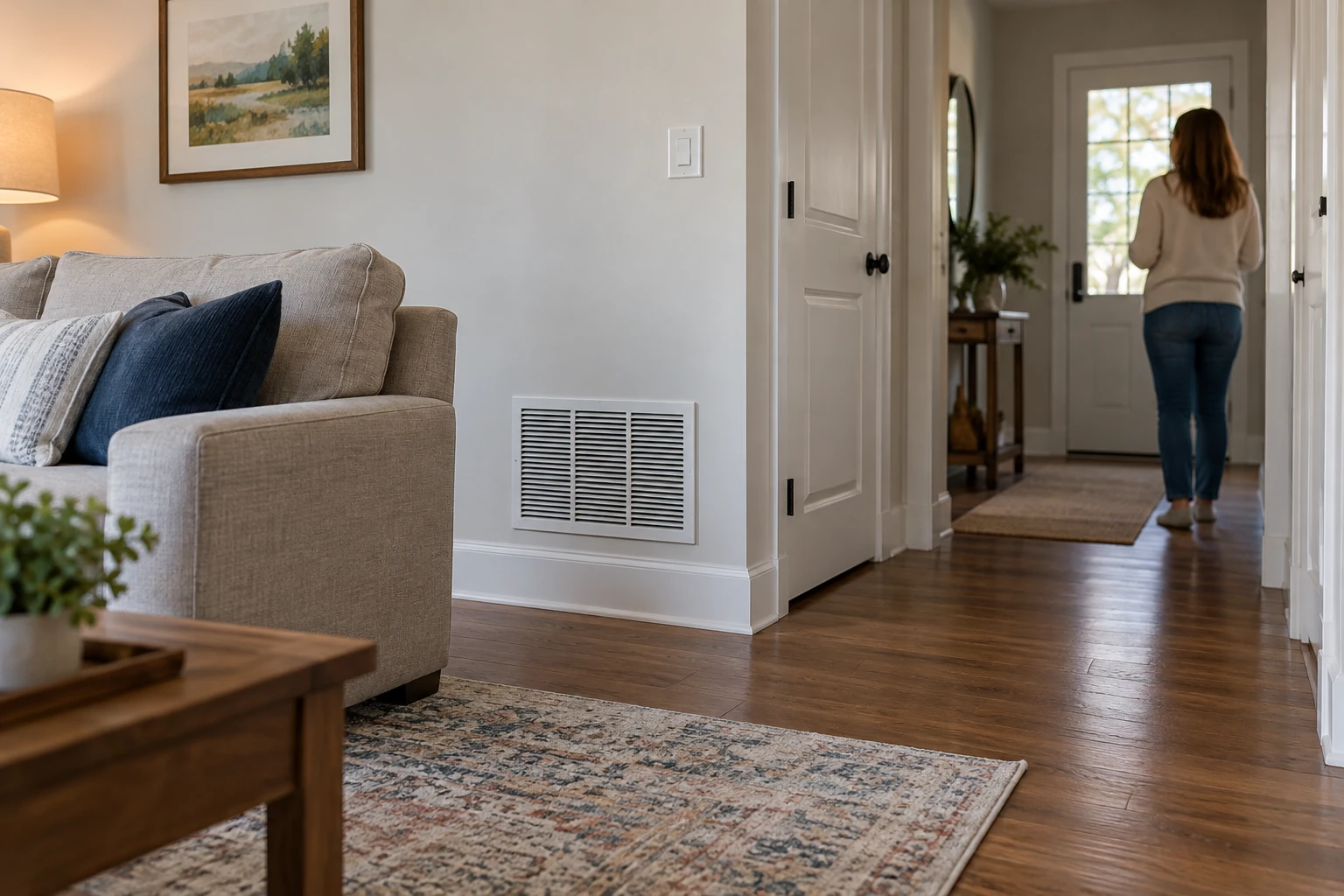
An unusual smell near an HVAC vent is a reason to pay attention, but it is not a reliable diagnosis. First decide whether the situation calls for leaving the area and urgent help. Only after immediate safety concerns have been ruled out should you spend time recording a non-emergency odor for a service company.
Do not move closer to equipment, open a cabinet, or keep the system running to identify a smell. An odor noticed at a vent may have traveled from somewhere else. This guide helps you describe the event and choose a safe next step; it does not identify mold, a refrigerant leak, or a failed component by smell.
Leave first if you suspect a gas leak
If you notice a sulfur-like or rotten-egg smell and suspect a gas leak, alert others and leave the area. Do not operate the thermostat, lights, appliances, garage door, or other electrical switches to investigate. Do not use a phone in the suspected leak area. Call emergency services and your local gas utility from a safe location.
PG&E's gas-safety guidance emphasizes evacuation and avoiding possible ignition sources. Its reporting number is for its own service territory; elsewhere, use your local utility's emergency contact. Do not attempt to locate, repair, or control a leak yourself.
You do not need to prove the HVAC equipment is responsible before taking a suspected gas leak seriously. A service appointment arranged for later is not a substitute for emergency assistance. Do not reenter or restart equipment until the appropriate responders say it is safe.
Smoke, burning, and alarms take priority over a smell record
Visible smoke, sparks, or a suspected fire means move away and contact emergency services as appropriate. Do not stay beside the unit to make a video or repeatedly restart it to reproduce the event. If there is uncertainty about an immediate hazard, prioritize safety over diagnosis.
Carbon monoxide is another reason smell cannot establish safety. The EPA identifies CO as an odorless gas. A home that smells normal can still have a CO problem. Treat a CO alarm or suspected exposure as an emergency and follow the alarm instructions and emergency responders' direction.
A working air conditioner, a filter, or an open window is not evidence that a combustion-related hazard has been resolved. Do not use this guide to decide an alarm is false or to test a furnace, gas appliance, or exhaust system.
For a non-emergency odor, describe the pattern
Once there is no immediate hazard, record where you first noticed the odor and what the system was doing. Use ordinary accessible rooms. Do not enter an attic or crawl space, remove a grille, or lean into an equipment cabinet to collect information.
| Detail | Useful observation | What it cannot establish |
|---|---|---|
| Location | First noticed in one bedroom or several rooms | The exact source inside the duct system |
| Timing | Present at startup, during operation, or even with HVAC off | A particular electrical or mechanical failure |
| Description | Damp, musty, chemical-like, or another plain description | Mold species, refrigerant identity, or safety |
| Related event | Began after painting, a leak, or recent work | Proof that the event caused it |
| Visible condition | A safely visible damp area or stain | The condition of concealed materials |
- Detail
- Location
- Useful observation
- First noticed in one bedroom or several rooms
- What it cannot establish
- The exact source inside the duct system
- Detail
- Timing
- Useful observation
- Present at startup, during operation, or even with HVAC off
- What it cannot establish
- A particular electrical or mechanical failure
- Detail
- Description
- Useful observation
- Damp, musty, chemical-like, or another plain description
- What it cannot establish
- Mold species, refrigerant identity, or safety
- Detail
- Related event
- Useful observation
- Began after painting, a leak, or recent work
- What it cannot establish
- Proof that the event caused it
- Detail
- Visible condition
- Useful observation
- A safely visible damp area or stain
- What it cannot establish
- The condition of concealed materials
Do not deliberately recreate the smell. A short note from an ordinary event is useful; repeated exposure is not. Record whether anyone reports discomfort and tell the provider, but do not use symptoms to make your own medical or equipment diagnosis.
If an odor is strong, persistent, or associated with symptoms, move to a safer environment and seek appropriate professional advice. You do not need a complete log before asking for help.
A musty smell deserves a moisture question, not a sales conclusion
EPA's mold-investigation guidance treats damp or musty odors as clues to a possible moisture problem. A clue is not confirmation of the source or an instruction to sample, spray, or clean the HVAC interior yourself.
If you can see wet materials from an ordinary room, report the location promptly. Our AC condensate drain guide explains safe reporting of water near equipment. Do not start by pouring chemicals into a drain or opening a pan.
A humidity reading can be separate useful information, but it does not locate a hidden leak. Use our indoor humidity guide for that measurement question. Do not accept an air freshener, fragrance, or a new filter as proof that a continuing moisture source is fixed.
Ask the provider to separate findings from recommendations
A useful assessment explains what was observed, which areas were evaluated, and what evidence supports the proposed work. Ask whether the issue concerns the equipment, a building material, a household activity, or something still unresolved. The answer may require an appropriate specialist beyond routine HVAC service.
If duct cleaning is proposed, ask what finding supports it. An odor alone does not tell you whether cleaning, sealing, water remediation, or another action is appropriate. Our duct sealing versus cleaning guide helps keep those scopes distinct.
Avoid authorizing a package solely because it promises to eliminate every odor. Ask what the work will address and how an unresolved or returning smell will be handled. Keep the written finding and any follow-up plan.
Keep the response within safe homeowner limits
Do not spray cleaners, fragrances, disinfectants, or other products into vents or equipment. Do not open electrical or combustion compartments, handle refrigerant, or bypass a switch. If the provider needs direct access, arrange that through the qualified professional rather than preparing the equipment yourself.
For a non-emergency service visit, our contractor and visit-preparation guide helps organize the conversation. Describe an odor as an observation, not as proof that a named part must be replaced.
Does a smell from a vent prove the ducts are dirty?
No. Air movement can carry an odor from another source. Ask for an assessment and evidence before approving a duct service.
Can I tell whether refrigerant is leaking by smell?
Do not use smell to establish refrigerant identity, leakage, or safe exposure. Move away from a concerning condition and seek appropriate help.
Should I keep running the system so the technician can smell it?
Do not prolong exposure or unsafe operation for demonstration. Record what happened and ask how to proceed safely.